Skip to content
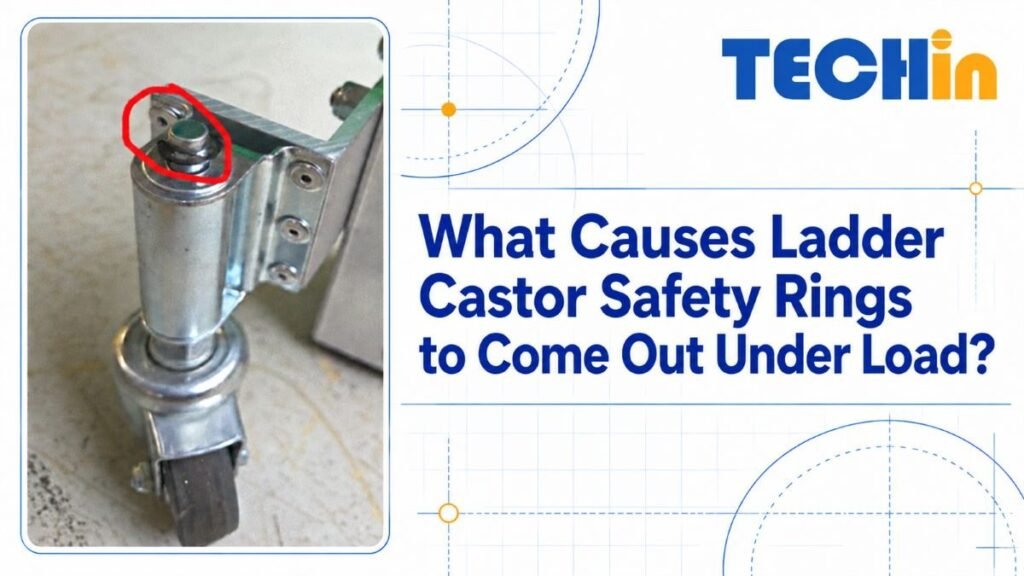
A ladder castor can lose its safety ring when its groove, assembly, or load path cannot retain the upper structure. This guide shows buyers how to inspect and test it.
Ladder castor safety rings can come out when groove support, ring fit, assembly seating, or applied force do not match. Spring return, impact, vibration, and relative movement can increase the load. Buyers should inspect the complete castor and confirm retention under representative dynamic conditions before release.

A customer reported a safety ring coming out. A shallow groove and spring-return force were suggested, but not confirmed.
What Is a Ladder Castor and Which Parts Matter Here?
A small castor can carry a moving assembly, so its retaining features must work with the wheel, housing, spring, and mounting parts.
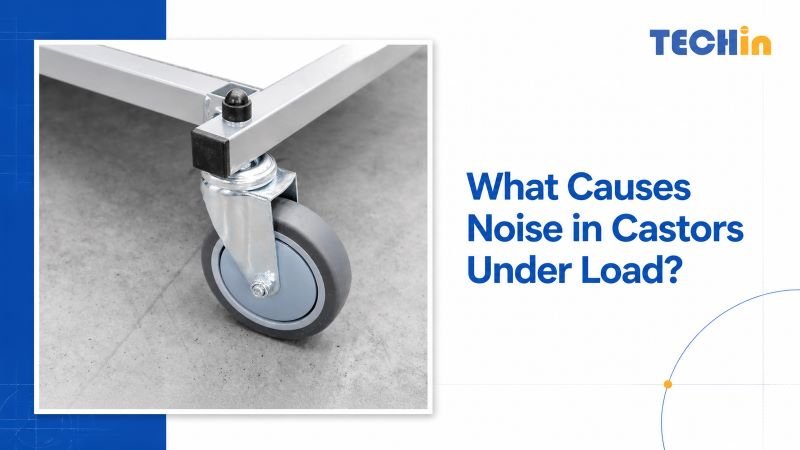
A ladder castor is a compact castor used to move ladder equipment. Its wheel, housing, spring action, and top safety ring work together. Assess the ring through the complete load path.
Here, safety ring is the case term. Retaining ring is the broader engineering term for a ring seated in a groove. Buyers should identify which part bears against the ring and what changes when the load is reduced.
A spring-loaded assembly can change position after the parts are fitted. The useful question is not only whether the ring is the right size, but whether the assembled castor supports it as designed.
Spring movement can change the finished position and the force reaching the groove.
The next question is how the ring and groove share load.
How Does the Safety Ring Hold a Ladder Castor Together?
The ring does not carry force by itself; the groove wall and retained part must transfer force into the castor structure.
The safety ring resists axial movement from its groove. Its support depends on ring section, groove geometry, supporting material, edge margin, and contact with the retained part.
Retaining-ring guidance treats ring shear and groove deformation as separate limits. The lower capacity controls the assembly, so a strong ring cannot compensate for a weak groove.[1] Wrong ring or groove dimensions can reduce engagement.
A square face transfers force more directly than a chamfer or radius; a rounded edge can tilt the ring and reduce groove-wall support.
Approve the ring and groove as a matched system. The drawing should state the controlled features, datum, measuring method, and acceptance limit. The assembled castor must then confirm that the approved parts engage correctly.
The next question is whether the load remains static during use.
How Can Load Push the Safety Ring Out of Its Groove?
Static weight is only one condition. A ladder castor may see changing load as the spring moves, equipment turns, or the wheel meets an uneven surface.
Spring return, sudden unloading, impact, vibration, and relative movement can create forces that a static check does not represent.
Rotor Clip identifies sudden loading, impact, vibration, and relative rotation as dynamic conditions that can affect retaining-ring assemblies. It also recommends actual application testing where such conditions exist.[3]
Separate the diagnosis into three checks:
- Seating: Does the ring remain fully engaged around the complete circumference?
- Deformation: Do the groove or retained parts move permanently after loading?
- Movement: Can an adjacent part rotate, tilt, or strike the ring during spring return or steering?
The spring-return explanation is worth testing, but it is not a confirmed cause. The test must show whether the ring remains seated or surrounding parts change position.
That leads to the controllable questions of groove fit and assembly.
Can a Wrong Groove Size or Incorrect Assembly Make It Come Loose?
A correct ring can still fail if the groove or installation is wrong.
Check the approved ring against the groove data, then confirm full-circumference seating after assembly. Groove depth alone is not enough; width, edge margin, corner shape, ring diameter, and seating height may also matter.
Inspect for a tilted section, damage, debris, excess grease, or poor tool alignment. Identify the approved spring or housing version in the drawing and release record.
Ochiai explains that groove deformation can disengage a ring and that edge margin affects groove thrust capacity.[4] The case has no verified groove measurement or seating record, so shallow depth is not a confirmed cause.
Before a design change, define the datum, instrument, load condition, limit, sampling stage, and retained record.
The next question is how buyers should test the finished ladder castor before release.
What Should Buyers Test Before Releasing Ladder Castors?
A certificate for one component cannot prove retention in the finished ladder castor.
Before release, define four checkpoints:
- Component: Confirm the ring and groove against the current drawing.
- Assembly: Check seating, height, axial play, cleanliness, and damage.
- Function: Run the retention check and relevant spring-return, impact, vibration, or steering condition.
- Release: Record the sample, lot, condition, result, and disposition.
Do not copy a universal pull-off value into a new specification. Set it from the approved design, application, and safety requirement. If load changes repeat, use a cyclic or dynamic method instead of relying only on a static certificate. Inspect the ring, groove, housing, and retained parts again.
This evidence supports a clear decision: approve, hold, or change.
Conclusion
Treat safety ring retention as a complete ladder castor requirement: confirm fit, inspect assembly, and test the dynamic load path before release.
References
- Rotor Clip, Formulas: Retaining Ring Load Capacity.
- Rotor Clip, Dynamic conditions in retaining-ring assemblies.
- Ochiai, Calculations for Retaining Rings.