A TPR castor can arrive with a broken plastic thread guard even when its wheel and tyre are intact. What should the buyer check first?
Plastic thread guards on TPR castors usually break when a thin guard edge takes local impact, compression, or rubbing during transport. Poor support, incorrect fit, or low impact resistance can increase the risk. Inspect the guard separately, then compare package contact, geometry, and material records.
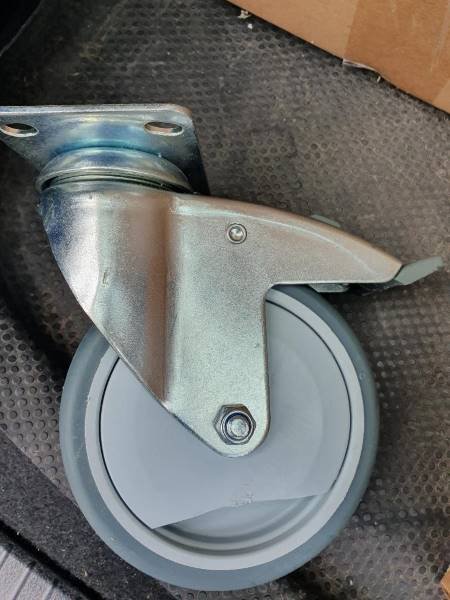
The grey plastic threadguard is fractured beside the TPR wheel, while the metal housing remains visible.
A customer contacted us after new TPR castors arrived with broken plastic thread guards. The castors had not been used, and the customer said the damage appeared during transport. We reviewed photographs showing fractured grey plastic at the guard area. The concern was simple and important: why did a protective component break before the castors entered service? That question is useful for any buyer who receives damaged castors.
How Does a Plastic Thread Guard Protect a TPR Castor?
A thread guard is a plastic or metal disc beside the wheel hub. It covers the bearing and exposed axle area, helping stop thread, hair, and other debris from wrapping around the moving parts. A thread-guard guide describes the same protective function.[1]
The guard is not the TPR tyre and it is not the wheel centre. That distinction matters during receiving inspection. If the guard is fractured while the TPR tyre remains intact, the first investigation should focus on the guard, its support, and the way the castor was packed.
What Makes a Plastic Thread Guard Break During Transport?
The most useful first step is to compare the fracture with the way the guard could have been loaded inside the package.
| What the buyer sees | Likely lead | What to check |
|---|---|---|
| A guard edge is broken where it could touch a carton, separator, or adjacent castor | Local impact or compression | Contact marks, clearance, movement, and stacking orientation |
| Several guards break at the same feature or edge | Geometry, material, or moulding consistency | Approved sample, guard drawing, plastic grade, and production comparison |
| The guard is displaced or rubbed but not fully broken | Movement or poor support in the package | Guard fit, axle clearance, separators, and carton pressure |
| The guard is broken and the wheel rubs or binds | Broken guard fragments or local misalignment | Wheel rotation, hub clearance, housing alignment, and loose pieces |
The same symptom can have more than one contributor. A thin edge may tolerate normal handling when it is well supported, but fail when a carton load presses directly on it. A material or moulding variation can reduce that margin further. The useful question is therefore not simply “was the material bad?” It is “which load reached the thread guard, and was the guard designed and packed to withstand it?”
How Should Buyers Inspect a Broken TPR Castor Thread Guard?
Inspect the package and the castor together. A receiving check should record the package before internal protection is moved.
- Photograph carton compression, punctures, wet areas, collapsed corners, and disturbed packing.
- Check whether the castors could shift, touch one another, or press a thread guard against the carton wall.
- Inspect both sides of the castor for a cracked, chipped, displaced, or missing thread guard.
- Check that the TPR tyre, wheel centre, axle, housing, and top plate are separate from the guard damage being reported.
- Rotate the wheel and swivel the housing by hand. Note rubbing, binding, noise, looseness, or misalignment.
- Compare a damaged castor with an approved sample and photograph the same viewing angle.
Do not force a damaged guard back into position. Keep any broken piece with the castor, because its shape can show whether the failure started at an edge, fixing point, or contact area.
What Material and Packing Details Should Buyers Confirm?
Ask for information about the thread guard as a component, not only the wheel specification.
- Which plastic family and grade were approved for the thread guard?
- Has the formulation, colour system, or supplier changed?
- What guard thickness, edge shape, and fixing detail are shown on the approved drawing or sample?
- How is the guard supported and kept clear of the carton, adjacent castors, and metal housing?
- Which separators, orientation, and stacking conditions apply to the final package?
These questions connect the customer’s observed breakage to checks that a buyer can document. They also keep the TPR tyre, wheel centre, and plastic thread guard from being treated as one interchangeable part.
How Should TPR Castors Be Tested Before Shipment?
The transport check should use the production castor and the final packing arrangement. ASTM D4169 provides a framework for evaluating shipping units against their distribution environment.[2]
Before regular shipment approval, agree a short test sequence:
- Pack production-equivalent TPR castors with the intended thread guards, carton, separators, and stacking orientation.
- Apply the drop or impact, vibration, and compression hazards that match the distribution route.
- Inspect the thread guards after each stage, not only after the package is opened.
- Define a pass as no cracked, chipped, displaced, or missing thread guards, and no wheel rubbing caused by the guard.
- If a guard breaks without a matching package contact point, compare the part against the approved sample and plastic grade.
The test record should name the castor configuration, packing arrangement, hazard sequence, inspection points, and pass criteria. “The carton is strong enough” is not a complete protection requirement.
Supplier-ready question: Can you show the approved plastic thread-guard sample, the final packing arrangement, and the transport-test pass record for this TPR castor?
Conclusion
Treat the broken thread guard as a component-specific receiving issue: check package loading, compare the approved part, and test the final packing arrangement before shipment.
Related Reading
The two sources below are included only to define the thread-guard function and the shipping-unit test framework used in this article.
References
- The Caster Guy, What Are Thread Guards and How Do They Work?.
- ASTM International, D4169 Standard Practice for Performance Testing of Shipping Packages and Systems.