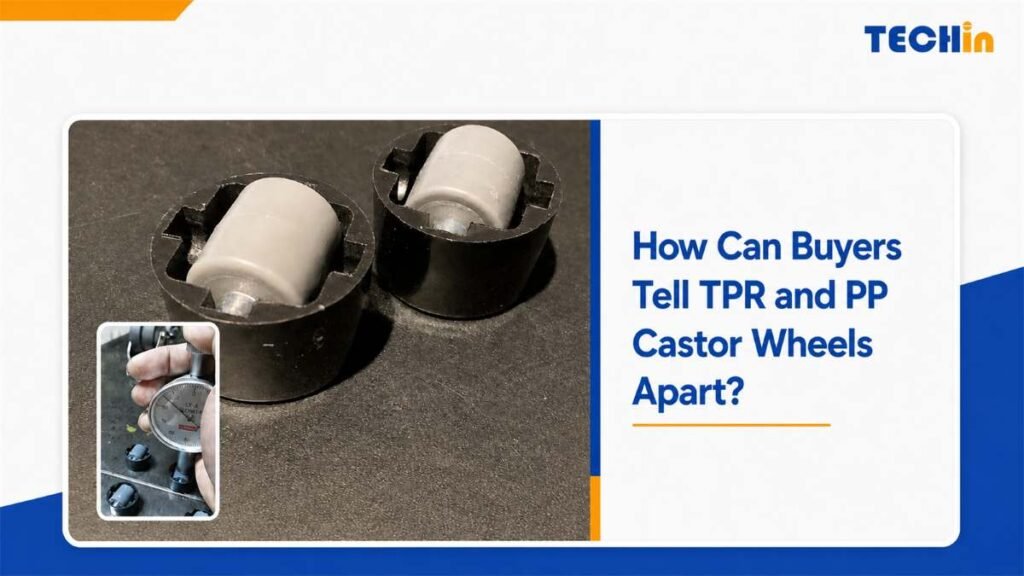
TPR and PP castor wheels can look similar while behaving differently in service, so buyers need a component-by-component comparison before acceptance.
TPR is normally the resilient contact layer, while PP is a harder plastic often used for a wheel centre. The drawing, approved sample, and consistent test are needed to confirm which material is where.
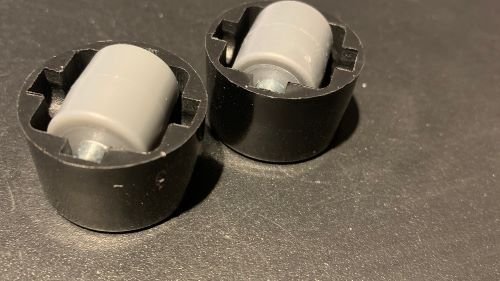
A customer contacted Techin Castor after finding two visibly different wheel types in a small inset castor order. The softer wheels behaved like the approved TPR sample, while some loose wheels appeared close to rigid plastic. We reviewed accepted and suspect samples. The follow-up confirmed PP in place of the specified TPR tread during a material changeover. The drawing was then updated to state a Shore A 85±5 tread requirement, giving future checks a defined reference.
What Is the Difference Between a TPR Tread and a PP Wheel Centre?
Start with the component, not the colour or touch.
The key comparison is between the tread that contacts the floor and the centre that supports the tread and axle interface. Compare the suspect wheel with an approved sample, then ask for the material record for the exact component. Treat a hard reading as a warning, not as proof of PP. ASTM D2240 describes durometer hardness as an indentation result, not a direct material-composition test.[1]
Use this sequence when a buyer needs to tell TPR and PP apart:
- Confirm the location. Identify whether the observation concerns the tread, wheel centre, housing, or axle. A castor can contain more than one material.
- Compare like with like. Use an approved sample and a suspect sample with the same assembled condition, surface preparation, and measurement method.
- Separate the questions. A hardness difference shows that the parts respond differently to indentation. It does not by itself prove which polymer was used.
- Request material evidence. Compare the drawing, bill of materials, material identification, and sample record for the exact component under review.
The complaint evidence illustrates why this order matters. The photographs showed visibly different parts, but the material conclusion came from comparing returned samples and confirming the tread material. The image alone could not establish chemical composition.
Can Hardness Alone Identify TPR or PP?
Shore hardness helps compare a TPR tread with an approved reference, but it cannot identify TPR or PP on its own. ISO 7619-1 identifies the Shore A scale for thermoplastic rubber in the normal-hardness range.[2]
The reading is useful when the buyer defines the conditions. The same number has little value if different inspectors use different scales, locations, or sample conditions. ASTM D2240 also notes that the indentor geometry and applied force influence the result.
Write these items into the product requirement:
- Tread material: State TPR or the approved material description, and identify the component location.
- Scale and range: State Shore A and the nominal target with its tolerance. The case drawing later recorded Shore A 85±5; this is a product-specific example, not a universal TPR range.
- Test method: Define the instrument type, surface condition, reading location, conditioning, and reading procedure.
- Sampling stage: State whether the check applies to the first piece, after material change, after restart, final inspection, or incoming inspection.
- Record: Keep the instrument identity, readings, sample identity, inspector, date, and drawing revision.
This turns “soft” and “hard” from subjective descriptions into a comparable acceptance decision. It also prevents buyers from treating a durometer result as a complete material certificate.
What Visual Checks Help Buyers Tell TPR and PP Apart?
The tread and wheel centre can have different materials and different jobs. The tread controls contact with the floor, while the centre supports the tread and axle interface.
For that reason, PP in a wheel assembly is not automatically a defect. The buyer must check whether the drawing calls for PP in the centre or housing, or whether PP has replaced the specified TPR tread. A product description from a European castor supplier shows this distinction in practice by listing a TPR tread with a polypropylene wheel centre.[3]
This distinction prevents two opposite mistakes:
- rejecting a correctly designed multi-material wheel because PP is present somewhere in the assembly;
- accepting a hard PP tread because the wheel still resembles the approved TPR part.
When the construction is small or the tread is thin, compare the component drawing and approved sample before selecting the test point. Do not place the durometer on the wheel centre or housing and treat that result as the tread value.
What Should Buyers Check Before Accepting TPR or PP Castors?
Use a three-part acceptance check: material identity, hardness, and assembled function.
ISO 22878 defines test methods and apparatus for checking castor and wheel performance. The appropriate test and acceptance value still depend on the product and application.[4]
Before acceptance, check the following:
- Material identity: Does the drawing identify the tread and wheel centre separately? Does the supplier record match the approved material description?
- Hardness consistency: Were suspect and approved samples measured with the same Shore scale and conditions? Does the result sit within the agreed product range?
- Assembly completeness: Is the wheel seated in the housing? Is the axle present and retained? Are there loose parts in the package?
- Free movement: Does the assembled wheel rotate without rubbing or binding? Is the clearance consistent with the drawing?
- Test record: Can another inspector reproduce the measurement from the recorded instrument, location, condition, sample, and drawing revision?
The ICWM guidance also links wheel material and size with load, rollability, and application requirements. This is why hardness should not be accepted as an isolated number. The buyer needs the complete castor configuration and the intended use when setting the final acceptance rule.[5]
Conclusion
To distinguish TPR from PP, identify the tread and wheel centre, compare them with the drawing and approved sample, test Shore A consistently, and check the assembled castor before acceptance.
Related Reading
- ASTM D2240 durometer hardness method
- ISO 7619-1 Shore hardness method
- ISO 22878 castor and wheel test methods
- ICWM key factors when specifying castors
References
- ASTM International, D2240 Standard Test Method for Rubber Property—Durometer Hardness. back
- International Organization for Standardization, ISO 7619-1:2010.
- L&K Rollen, TPR castor product reference.
- International Organization for Standardization, ISO 22878:2004 Castors and wheels—Test methods and apparatus.
- MHI Institute of Caster & Wheel Manufacturers, Key factors when specifying castors.