Skip to content
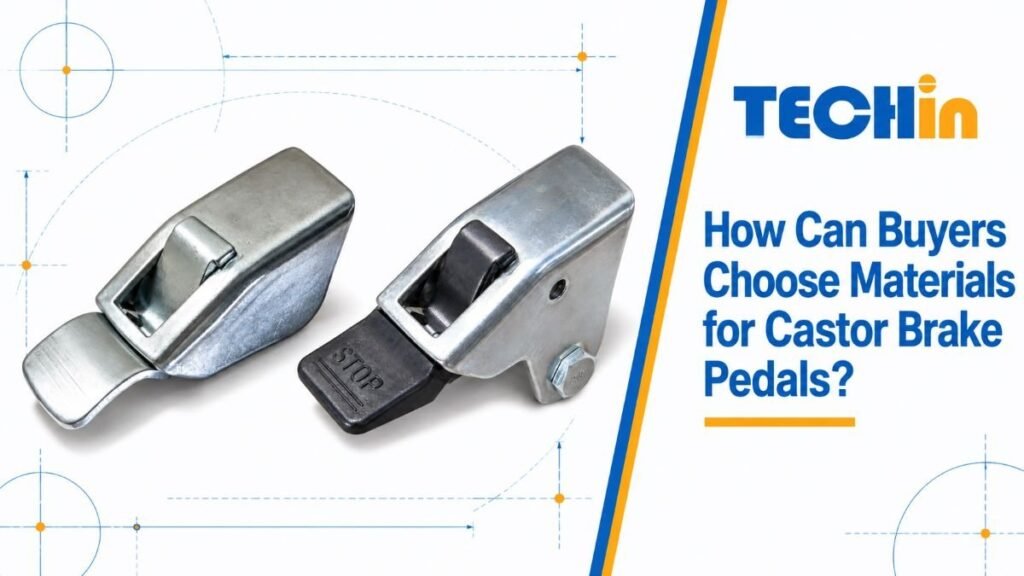
A castor brake pedal is small, but it controls an important action. Choose material for its real work.
Buyers should compare steel, stainless steel, and nylon/PA by the pedal’s function, force, use pattern, and workplace conditions. Then check the finished pedal in the complete castor and approve the material with clear test evidence before production approval.
A customer reported brake pedal breakage, raising a practical material question. The buyer requested EN testing before approving a material change. This guide compares materials and working conditions before production approval.

What Is a Castor Brake Pedal?
A castor brake pedal is the part a user presses to apply or release the brake.
It transfers hand or foot force through a pivot to a brake contact, helping the castor hold or move as intended.
The pedal works with the housing, pivot, fastener, brake contact, and wheel or swivel-lock parts. Its material affects stiffness, weight, wear, corrosion resistance, and noise. But material alone does not decide performance. A suitable grade can still work badly if the pedal is too thin, the pivot is loose, or the brake travel is wrong. Buyers should therefore describe the complete pedal function before comparing material names. The force path and user contact must be clear before final material approval for production. This definition sets the baseline for the next question.
What Must a Castor Brake Pedal Handle?
The material must match the force and movement that the finished pedal will see.
Check force, repeated use, brake travel, pivot support, fit, and contact with nearby parts before choosing a material.
Record the expected castor load, how often the brake will be used, how the pedal will be pressed, and how much space is available. Check whether the pedal must hold a brake, release it, or control a swivel lock. Also check the pivot, fastener, housing clearance, and brake contact. These details explain why a material is being considered and what the sample must prove. A material that looks strong on paper may still bend, crack, wear, or stick when the design does not support it. This leads to the material comparison that follows.
How Do Steel, Stainless Steel, and Nylon/PA Compare for Castor Brake Pedals?
Each material group offers a different balance of stiffness, corrosion resistance, weight, noise, and wear.
Steel supports stiffness and repeated force; stainless steel helps where corrosion matters; nylon/PA can reduce weight and noise but needs closer checks on heat, moisture, creep, and wear.
Steel is a practical starting point where stiffness and repeated force are important. Check rust protection and bending. Stainless steel suits wet, cleanable, or corrosion-prone workplaces, but the exact grade still needs confirmation. Nylon/PA may suit lower-force applications where weight or noise matters; check its grade, temperature, moisture, creep, and pivot wear. For all three, confirm thickness, support, and brake contact. Compare the pedal under the same force and movement instead of comparing names alone. Reference 2 gives product terminology only2. The next step is to check workplace conditions.
Which Workplace Conditions Matter for Castor Brake Pedal Materials?
The same material may behave differently in different workplaces.
Check load, brake operations, water or cleaners, temperature, corrosion, contact wear, and the cost of failure before approval.
High force or frequent use points first to steel or stainless steel. Corrosion and wet cleaning favour stainless steel. Lower weight or noise may point to nylon/PA, but only with a defined grade and support. On the sample, confirm grade and drawing, fit the pedal, cycle the brake, and look for cracks, bending, whitening, loose pivots, sharp edges, or lost contact. Before production, agree the EN test scope and acceptance limits. Reference 1 lists the standard; agree the actual test plan1. This check leads to the production decision.
Before approval, use this short check:
- Confirm the grade and drawing revision.
- Test the complete castor under expected force and movement.
- Record cracks, bending, loose pivots, or lost contact.
- Agree EN scope and limits before production.
This check leads to the production decision.
Conclusion
Choose the material by the pedal’s function and workplace, then verify the finished castor before approval.
References
- DIN EN 12527 — reference.
- Blickle catalogue — terminology.