Skip to content
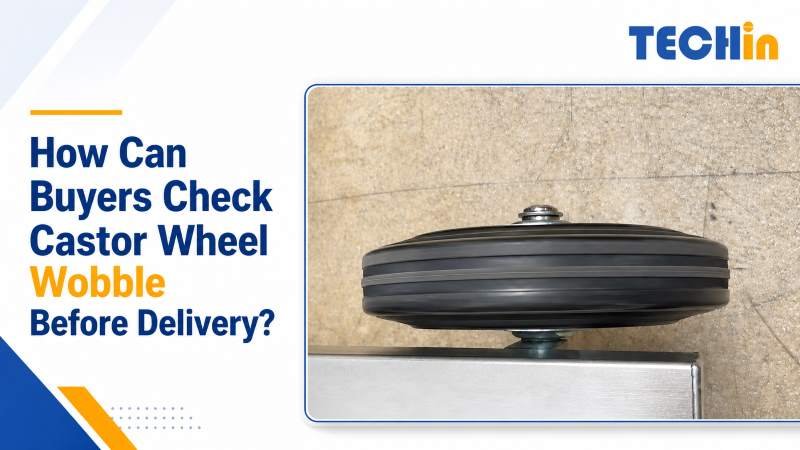
Wheel wobble can reach a buyer late in delivery. A visual spin test may show movement but not its source.
Buyers should check the wheel on a controlled axle, measure radial and lateral movement with a dial indicator, then repeat the check on the mounted assembly. Record the fixture, load, rotation method, sample, and agreed pass limits.[1]
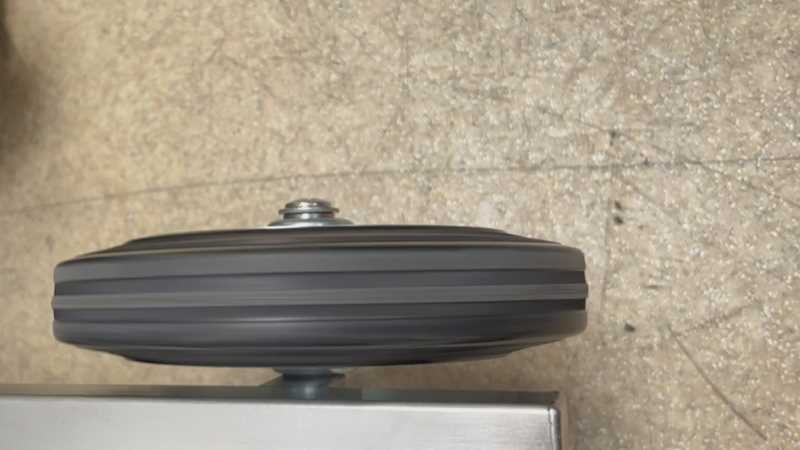
Wheel and support visible during a rotation check.
A customer contacted us after a 200 × 50 mm electrically conductive rubber wheel was reported as wobbling. We separated the symptom from possible causes. The product used an iron core, roller bearing, 20 mm bore, and 60 mm shaft length. Evidence does not establish one cause, so test the wheel and assembly separately.
What does castor wheel wobble actually show?
Wobble is an observation, not a diagnosis. Radial runout is movement towards and away from the rotation centre. Lateral runout is side-to-side movement. Both can come from wheel roundness, wheel-centre concentricity, an axle or bore issue, bearing seating, or assembly play.
The first useful question is whether the movement follows the wheel or appears only after mounting. European castor test methods include wheel play and dynamic checks, which supports a defined test setup rather than a subjective judgement.[2]
How can buyers test and inspect the source?
Use this sequence before assigning responsibility:
- Check the wheel alone. Mount it on a known straight axle or mandrel. Place a dial indicator at the tread for radial movement and at the wheel face for lateral movement. Rotate slowly and record total indicator movement.
- Check the mounted assembly. Install the specified axle, spacers, washers, and fastener. Repeat the measurements under the agreed assembly condition.
- Compare the results. If the wheel is stable alone but moves after mounting, inspect the bore, axle straightness, bearing seating, spacer stack, and fastener adjustment. Bearing fit and out-of-round support surfaces can affect clearance and running behaviour; bearing maintenance guidance gives fit and clearance context.[3]
Do not invent a universal tolerance from a video. The pass limit should match the wheel design, load, speed, floor, and application. A supplier should state the measurement point and method with the limit.
Which measurements should a castor supplier record?
A useful inspection record should answer four questions:
- What moved? Record radial and lateral total indicator movement, with the gauge position.
- How was it tested? Record the axle or mandrel, load, rotation speed, fixture, and assembly condition.
- What could affect the result? Record bore size, bearing seating, axle condition, spacers, washers, and fastener setting.
- What was released? Record the sample size, product or lot reference, agreed pass limit, result, and inspector.
Castor testing is stronger when post-test checks are documented, not kept as an informal visual decision.
What should buyers ask before delivery?
Ask the supplier to confirm:
- the radial and lateral runout limits for the specific wheel;
- whether the limit applies to the wheel alone, the mounted castor, or both;
- how the 20 mm bore and roller-bearing seating are checked;
- the sampling plan and records supplied with the release decision.
Conclusion
These questions turn “the wheel wobbles” into a repeatable technical check. Before delivery, require component-isolated runout results, assembly-fit checks, and a documented pass decision under the intended application conditions.
Useful Resources
- EN 12527 castor and wheel test methods
- SKF bearing maintenance guidance
- Castor testing and post-test documentation