When an adjusting ring stops on a castor axle, assembly can halt even when the nominal size appears correct.
Buyers should specify the axle and adjusting ring as one mating system: actual limits, fit type, measurement method, and functional pass condition.
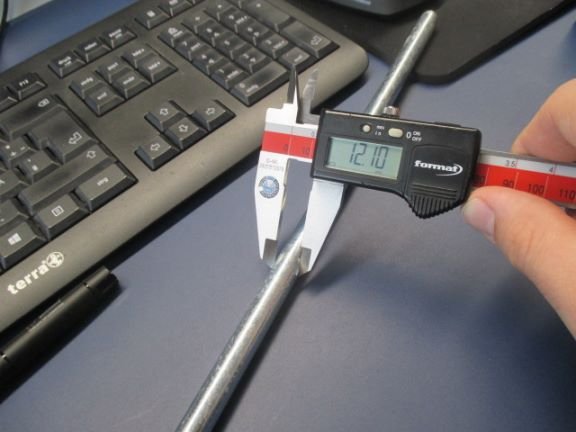
This is an inspection illustration, not a customer-case photograph or a 12.10 mm measurement.
A customer reported that an adjusting ring would not reliably pass over a supplied axle. The customer described variable outside diameter and thickness above 12 mm. Submitted photographs show a digital-caliper display of 12.10 and a ring stopped on the axle. The case shows why a nominal axle diameter is not a complete mating specification.
What does the castor axle’s adjusting ring need to fit?
The ring bore and axle outside diameter form one fit. Buyers should control them as a pair and define whether the ring must slide over the axle, locate it, or clamp it.
The customer referred to an adjusting ring made according to DIN 705 with an H8 diameter tolerance. DIN Media lists DIN 705:2019-03 as an adjusting-ring standard; the order should still identify the exact drawing, size, edition, and applicable tolerance.[1]
Why is a nominal 12 mm castor axle not enough?
A nominal size does not state how far the actual part may vary. For a pass-over or clearance fit, the ring’s minimum usable bore must remain larger than the axle’s maximum permitted outside diameter by the agreed clearance.
Timken’s engineering manual treats the two components’ tolerances as a combined decision. The required fit depends on clearance, location, interference, and operating conditions.[2] Do not choose clearance without checking assembly method, movement, retention, temperature, and surface condition.
How should buyers write a castor axle tolerance?
State these points in the drawing or purchase specification:
- Mating ring: part number, bore, standard, and drawing revision.
- Axle limits: nominal outside diameter plus upper and lower limits.
- Fit type: slide, locate, or clamp, with the assembly method.
- Measurement: instrument, resolution, calibration status, positions, and temperature when relevant.
- Functional pass: an approved ring or master ring must pass without abnormal force.
- Release record: readings and fit results the supplier must retain.
This makes the requirement measurable and supports consistent approval of samples and production lots.
Should castor axle inspection include a fit check?
Yes, when the customer assembles the axle and ring together. A caliper measures a location; a fit check verifies the mating function.
Mitutoyo distinguishes variable measurement from go/no-go inspection.[3] A release plan can combine readings at agreed positions, a calibrated ring gauge or approved customer ring, a defined pass condition, and the instrument and result records.
The case photos show why both checks matter: the caliper records one location, while the stopped ring shows the assembly consequence. Neither image alone defines the lot-release standard.
What should buyers ask before approval?
- Which ring bore limits and drawing revision set the axle limits?
- What are the maximum and minimum readings from approved samples?
- Where along the axle was each reading taken?
- Was the actual ring, a master ring, or a ring gauge used?
- What counts as a pass, and which records accompany release?
What is the shortest buyer checklist?
Identify the mating drawing; state axle upper and lower limits; define fit and clearance; name calibrated measurement positions; include a functional ring check when assembly depends on it; and require both dimensional readings and fit results in the release record.
Conclusion
Specify the axle and ring together, define the fit, and verify actual size and functional passage before release.
References
- DIN Media, DIN 705:2019-03 — Adjusting rings.
- Timken, Engineering manual on fitting practice.
- Mitutoyo, Product Fundamentals.