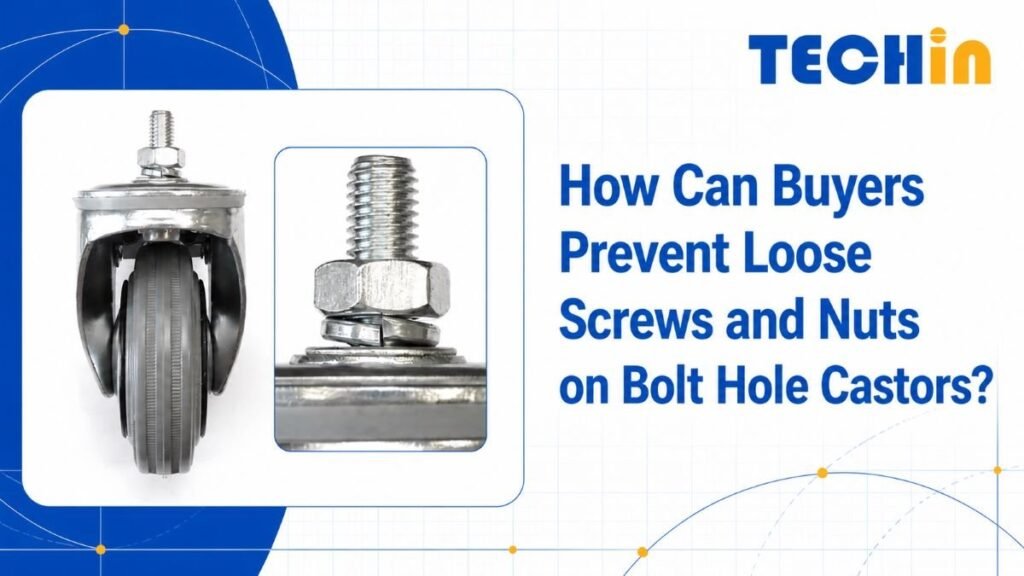
A loose screw and nut assembly on a bolt-hole castor can stop an urgent delivery, create rework, and damage buyer confidence. A clear torque and inspection requirement prevents the problem.
Buyers prevent loose screws and nuts on bolt hole castors by specifying the correct product torque, delivered condition, and functional checks. They should verify fastener seating, torque records, and free swivel movement before onward shipment.
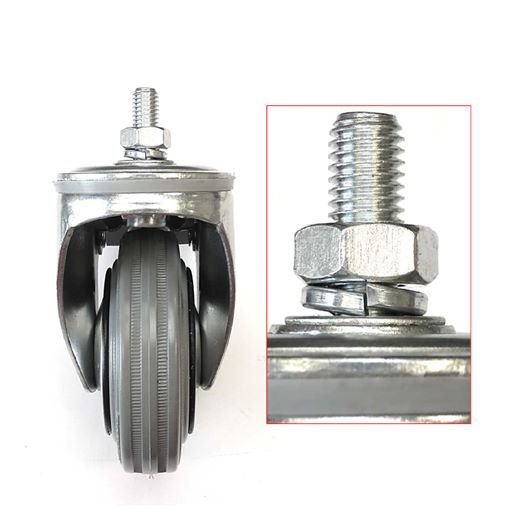
The enlarged fastener area shows visible thread above the nut. The image supports a loose-fastener observation, not a torque measurement.
A customer contacted us after two 100 mm grey rubber bolt-hole castor variants arrived with the M10×40 socket-head fixing screw/stem and M10×8 nut not tightened properly. The castors were used as delivered, so the issue became a downstream rework problem. During follow-up, the required delivered condition was clarified: the fastener had to be tightened to 20 Nm, could not be released by hand, and the castor was not to be supplied in separate pieces. We reviewed the product text and confirmed that this requirement was already documented.
What Causes Loose Screws and Nuts on Bolt Hole Castors?
A loose screw and nut assembly at delivery usually points to a gap between the product requirement and the assembly check. The first risk is hand tightening without a controlled torque value. The second is an unclear fastener stack, where the washer, spring plate, housing, or nut position is not defined.
The third risk is a wrong assumption about the delivered condition. Some castors are supplied with fasteners for customer-side assembly. Others are expected to arrive ready for use. If the buyer uses the castor as delivered, that difference changes the acceptance requirement.
Transport may expose a weak assembly, but the complaint evidence does not prove transport was the cause. A buyer should first separate three questions:
- Was the fastener assembled in the required position?
- Was the specified torque applied with a suitable tool?
- Does the finished castor still swivel freely without abnormal play?
These checks are related, but they do not replace one another. A visible nut position cannot prove 20 Nm. A hand-release check cannot prove a calibrated torque value. A torque check alone cannot confirm that the swivel action is acceptable.
How Should Buyers Specify Torque for Bolt Hole Castors?
The purchase specification should name the complete bolt-hole castor assembly condition, not only the word “tight”. Use the following minimum requirement:
Assemble the stated fastener stack to the product-specific torque. Supply the castor in the agreed delivered condition. Confirm that the nut cannot be released by hand and that the swivel action remains free, without abnormal play.
Do not copy 20 Nm from one castor to another. Technical guidance shows that torque depends on the fixing design and the material around it. Blickle’s fitting guidance explains that the fitting and the equipment construction affect the required tightening value.[1] An OEM service manual for a different castor assembly also uses a defined torque sequence before checking free rotation and bearing play, showing why the product-specific instruction matters.[2]
For a buyer, the requirement should answer five points:
- Which castor model and fastener are covered?
- Which washer, spring plate, and nut arrangement is required?
- What torque value and tolerance apply to this product?
- Must the castor arrive fully assembled or with parts supplied separately?
- What counts as a pass for hand release and swivel movement?
For the case product, 20 Nm was the documented requirement. It should remain a case-specific product instruction, not a general recommendation for all castors.
What Should Outgoing Bolt Hole Castor Inspection Check?
Outgoing inspection should check both the numeric requirement and the finished function. A practical sequence is:
- Confirm the model and assembly drawing. Check the wheel diameter, bolt-hole swivel housing, brake version where applicable, M10×40 screw/stem, washer, spring plate, and M10×8 nut.
- Verify the torque. Use a calibrated torque tool when the purchase specification names a numeric value. Record the first-piece result and the agreed sample or inspection result.
- Check the visible fastener position. Confirm that the nut is seated as specified and that the exposed thread matches the approved sample or drawing.
- Check hand release as a secondary acceptance test. The fastener should not release by hand when the product requirement says so. This is a practical check, not a replacement for torque measurement.
- Check movement and play. The swivel castor should turn as designed, while the housing should not show abnormal looseness. The same service-manual example requires free rotation with no bearing play after installation.[3]
The sequence matters. If the nut position is wrong, a torque reading may not represent the intended assembly. If the castor is tight but difficult to swivel, the assembly needs technical review rather than more tightening.
How Can Buyers Check Delivered Bolt Hole Castors Quickly?
The receiving check should be short enough to use on every delivery and detailed enough to catch a repeated issue. Use this four-part release gate:
| Check | Buyer action | Pass condition |
|---|---|---|
| Model and version | Compare the castor with the order and approved sample | Correct wheel, housing, stem, and brake version |
| Fastener seating | Inspect the nut, washer, spring plate, and exposed thread | Assembly matches the agreed drawing or sample |
| Torque evidence | Review the supplier’s torque result or test an agreed sample | Result matches the product-specific requirement |
| Function | Move the swivel housing and operate the brake where fitted | Free movement, no abnormal play, and correct brake action |
Do not solve an unclear requirement by tightening the nut as hard as possible. An OEM loose-castor procedure uses the correct washer order and a controlled two-spanner tightening method, showing why “as tight as possible” is not a transferable specification.[4]
If a sample fails, record the product model, the visible condition, and the check performed. Then ask the supplier to confirm the product-specific torque, the delivered condition, and the action for the affected stock. This creates a technical record without guessing the cause.
Conclusion
Buyers prevent loose screws and nuts on bolt-hole castors by specifying product-specific torque, assembled condition, fastener position, and free-movement checks, then verifying them before onward shipment.
Useful Resources
- Castor fitting types and tightening guidance
- Mirage Service Manual, wheel assembly guidance
- Fixing a Loose Caster (Wheel)
References
- Blickle, Fitting types.
- Invacare, Mirage Service Manual, wheel assembly guidance.
- Invacare, Mirage Service Manual, wheel assembly guidance.
- Goodnature, Fixing a Loose Caster (Wheel).