Skip to content

Cold storage can make a TPR castor hard to steer even when it moves normally at room temperature. A trolley may turn slowly or need extra force.
A TPR castor can stop swivelling in cold conditions when lubricant thickens or loses flow, raising resistance in the swivel bearing. Moisture, ball race condition, assembly, mounting, load, and wheel-bearing friction can add to the symptom. Buyers should condition the complete castor, then test swivel movement and wheel rolling separately before approval.[1]
The useful diagnosis is not simply “change the grease”. First identify which movement is resistant, then connect it to the castor and test method.
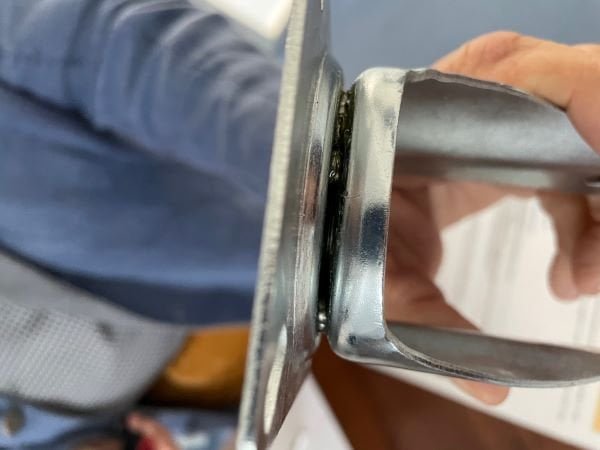
What Changes Inside a Swivel Castor in Cold Conditions?
The symptom is visible, but it does not show which interface is resisting.
Direct answer: Cold can increase resistance through thicker grease, moisture or ice, changed clearances, and rough or misassembled contact surfaces. Wheel rolling may also slow, so the two movements need separate checks.
Cold affects lubricant flow and moving surfaces. A grease that feels acceptable at room temperature may create higher starting resistance in the cold. Condensation can freeze around a bearing or add drag. General castor guidance links low temperature with reduced swivel and rolling performance.[2]
A cold-storage application illustrates this distinction. After refrigerated exposure, a 100 mm TPR swivel castor was reported to have hard swivel movement and slower wheel rotation. These symptoms identify the problem, but not one final cause. Condition the complete castor and mating equipment before judging movement.
The next step is to compare the product and assembly controls that can create resistance.
How Do Grease, Ball Race Condition, and Assembly Affect Movement?
Changing the grease may help, but it does not replace an inspection of the swivel assembly.
Grease, ball race condition, and assembly consistency can each change starting resistance. A low-temperature label is not proof that the complete castor will move correctly.
State the service temperature and approved grease grade. A claim such as “suitable to -20°C” matters only when the complete castor meets the agreed movement requirement. Cold-resistant guidance also distinguishes grease locations in the bearing and swivel section, while condensation can impair movement.[3]
Check three separate points:
- Grease: suitable flow and compatibility at the lower temperature.
- Ball race and assembly: clean, correctly filled, correctly tightened, and undamaged.
- Wheel path: axle, wheel, or plain bearing free from separate drag.
The case separates the TPR wheel material from the swivel-head issue. Changing the wheel compound will not automatically correct swivel resistance. Compare the same configuration after the same cold exposure and record the grease and production identity.
This prevents approval based only on a material name or temperature statement.
How Can Buyers Separate Swivel Resistance from Wheel Rolling?
A wheel can roll while the housing is difficult to turn. One movement cannot approve the whole castor.
Check swivel movement and wheel rolling separately, first without load and then under the intended mounting and load condition.
Record a room-temperature baseline, then repeat it after cold conditioning:
- Turn the housing with the wheel clear of the floor.
- Check wheel rotation through the axle and plain-bearing system.
- Repeat the check on the actual trolley or equipment under load.
A free-rolling wheel does not prove that the swivel head will track correctly. A free swivel does not prove that the wheel will roll under load. Alignment, mounting flatness, load distribution, and floor contact can change the result. Inspection guidance also separates swivel, wheel, and loaded travel checks.[4]
The result shows whether the next decision concerns grease, the ball race, axle, mounting, load, or application.
How Should Buyers Check Castors Under Cold Storage Conditions?
“Suitable for cold storage” is too broad to be a complete purchase requirement. A sample test is weak if it does not represent the real trolley.
Specify temperature, conditioning time, load, movement checks, pass criteria, and records before approval.
Define the lower operating temperature and exposure cycle. State whether the castor stays cold, moves between warm and cold areas, or faces condensation. Record:
- castor configuration, grease, and production identity;
- conditioning temperature and time;
- mounting arrangement and applied load;
- separate swivel-start, continued-swivel, and wheel-rolling results;
- the agreed pass criteria and inspector’s result.
Use an approved sample for comparison. Do not invent one universal torque limit when the application has not defined one. If the castor has a brake, check it in the same cold condition.
This turns a general temperature promise into a repeatable purchasing requirement.
Conclusion
Separate swivel and wheel movement, then specify grease, conditioning, load, checks, and pass criteria before approving a cold-storage castor.
References
- BIL Group, Castors and Wheels Technical Reference Guide.
- BIL Group, Castors and Wheels Technical Reference Guide.
- Hammer Caster, Industry Catalogue.
- HMI-Basen, Inspect Castors.