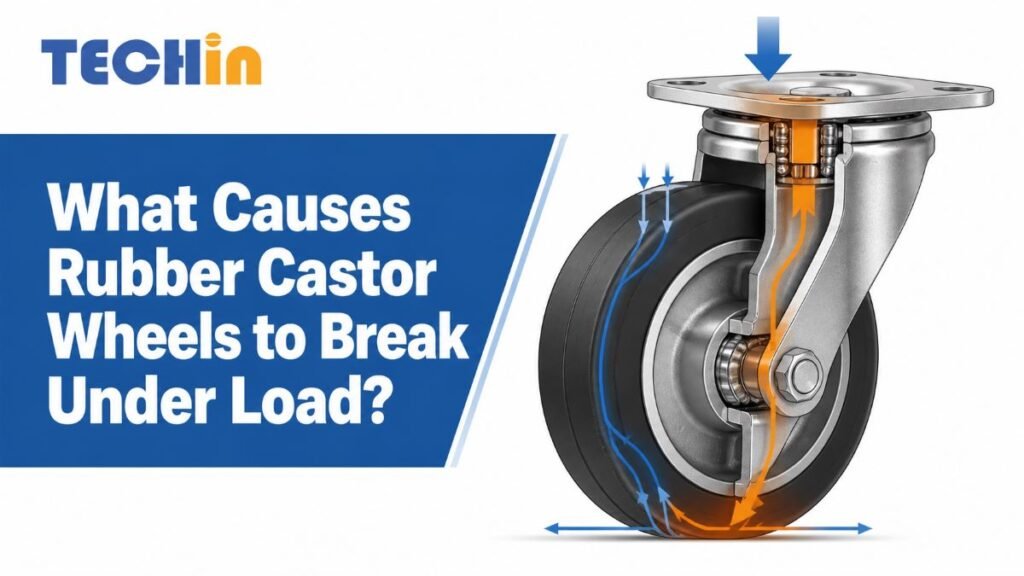
A rubber castor wheel can look correct at inspection and still break after repeated loading. That creates downtime and disputed specifications.
Rubber castor wheels usually break under load when cyclic force exceeds the tread or wheel assembly’s ability to hold its shape. Common paths include tread tearing, unstable rubber-to-rim fit, weak retention, impact, and unsuitable test conditions.
A customer contacted Techin Castor after an external test of 100 mm rubber industrial castors. Under a 70 kg load, the fixed castor wheel’s rubber ring broke at 5,734 of 15,000 cycles, while the swivel version passed. We compared that result with an internal five wheel check and reviewed whether the rim or rubber tread was driving the failure. The documented engineering direction focused on tread-thickness variation, rubber-to-metal-rim fit, and riveting stability.
What happens inside a rubber castor wheel under load?
The wheel carries more than a vertical force. Each obstacle and start-stop event changes how the rubber and rim share the load.
A rubber tread compresses and recovers as the wheel rolls. If tread thickness, rim geometry, or retention force varies, the interface can move repeatedly until the rubber tears or separates. Dynamic castor guidance also treats ground, environment, load, speed, and manoeuvrability as connected selection factors.[1]
| Visible symptom | Possible failure path | Buyer’s first check |
|---|---|---|
| Circumferential crack or split | Tread fatigue, local stress, or unsuitable compound | Tread thickness, hardness, edge condition, load, and speed |
| Rubber lifting or peeling from the rim | Interface movement or insufficient retention | Rim profile, tread dimensions, assembly method, and retention record |
| Rim movement or loose rivets | Riveting or flanging does not hold the tread securely | Rivet pattern, head formation, tool setting, and post-assembly check |
| Flat spot or rapid deformation | Excess load, repeated impact, or unsuitable wheel material | Dynamic capacity, obstacle condition, and operating temperature |
| Bearing or hub movement with an intact tread | Axle, bearing, hub, or side-clearance problem | Bore, hub length, axle, washers, spacers, and housing clearance |
The first visible symptom does not prove the cause. It tells the buyer which part of the assembly to inspect before repeating the same test.
How can tread thickness affect the rubber-to-rim joint?
The tread must be thick and consistent enough for the selected rim and assembly method to retain it under repeated load.
Thickness variation changes how much the tread is compressed or captured by the rim. A tight fit can stress the rubber, while a loose fit can permit movement that accelerates tearing. In the case reviewed here, the recorded engineering direction focused on this relationship, but the available evidence does not establish one universal tolerance.
Not all rubber wheels hold the tread in the same way. European wheel-construction information shows solid rubber treads pressed onto plastic rims, rubber tyres retained on repeatedly riveted metal rims, and elastic rubber directly vulcanised to a rim.[2] The inspection method must match the construction.
Before approval, the drawing or purchase specification should state:
- tread material and hardness range where relevant;
- wheel diameter, tread width, and tread thickness at defined measurement points;
- rim material, profile, and critical interface dimensions;
- assembly method, such as pressed, riveted, or vulcanised;
- allowable dimensional variation and the post-assembly retention check;
- the sample stage covered by each inspection record.
Do not use the nominal wheel diameter as a substitute for an interface specification. A 100 mm wheel can still have a different tread profile, rim fit, or retention condition.
Which checks should buyers use before approving a castor wheel?
A short inspection sequence catches more useful information than a visual check of one sample.
Use this order:
- Confirm the complete construction. Record the tread, wheel centre, bearing, axle arrangement, housing, and assembly method. Material names should identify each component.
- Measure the wheel interface. Check diameter, tread width, tread thickness, rim dimensions, bore, and hub length at defined points. Keep hub length separate from bore and width; the castor wheel hub and axle fit affects side clearance and axle loading.
- Inspect the assembled joint. Look for gaps, lifting, uneven compression, cracked rubber, displaced rivets, or rim movement. Repeat the inspection after the wheel is installed in the intended housing.
- Compare several samples. Record the spread between samples, not only the best result. Mixed results from a small check should trigger a review of the inspection method and sample coverage.
- Set visible fail conditions. Examples include tread separation, permanent deformation, loose rim movement, exposed sharp damage, bearing binding, or a change that affects safe rolling.
The result should be a record that another inspector can repeat. Include the drawing revision, instrument, measurement location, sample identity, assembly state, readings, and acceptance limit.
How should buyers test a castor under dynamic load?
Use the relevant standard and reproduce the intended wheel, housing, load, speed, floor, obstacle, and temperature conditions.
EN 12532 covers castor and wheel dimensions, classification, and test requirements for industrial applications up to 1.1 m/s.[3] A technical guide describing the EN 12532 and ISO 22883 framework lists constant speed, obstacles, a defined number of revolutions, temperature, rest periods, and a hard horizontal floor as part of the dynamic-capacity test conditions.[4] Confirm the exact edition, product scope, and acceptance rule before testing.
Record these fields for each sample:
| Test record field | What to record |
|---|---|
| Complete castor | Wheel diameter and width, tread, wheel centre, bearing, axle, housing, and fitting |
| Applied load | Load value, distribution, number of castors, and whether the load is static or moving |
| Motion conditions | Speed, direction, floor, obstacle geometry, and start-stop sequence |
| Environment | Temperature, conditioning, moisture, and any relevant surface contamination |
| Initial condition | Dimensions, visible condition, free rolling, and agreed reference sample |
| Individual result | Sample number, cycles completed, first visible change, failure mode, and final result |
| Post-test condition | Tread separation, deformation, rim movement, bearing condition, axle security, and housing damage |
Test the complete assembled castor when the application uses a complete assembly. Complete castor brake testing follows the same principle for braked products: the fitted wheel and housing can behave differently from a loose component.
What should a buyer ask the castor supplier to confirm?
Ask questions that connect the drawing, assembly, inspection, and test record.
- Is the rubber tread pressed, riveted, bonded, or vulcanised to the wheel centre?
- Which tread-thickness and rim dimensions are critical to retention?
- Where are those dimensions measured, with which instrument, and at what inspection stage?
- What post-assembly check confirms that the tread and rim remain secure?
- Which exact wheel, housing, bearing, load, speed, obstacle, and temperature were tested?
- How many samples were tested, and what did each sample do?
- What visible condition counts as a failure before complete wheel separation occurs?
- If the design or mould changes, which tests must be repeated before approval?
These questions turn “the castor passed” into evidence that can be compared between samples, sizes, housings, and production stages.
Conclusion
The main causes are interface movement, tread variation, weak retention, and unsuitable dynamic conditions. Specify the joint, inspect sample variation, and test the complete castor.
Related Reading
References
- Elesa Ganter, Castors and Wheels technical data.
- Gesa Transporttechnik, Wheels and castors.
- AFNOR Editions, NF EN 12532.
- Elesa Ganter, Castors and Wheels technical data.