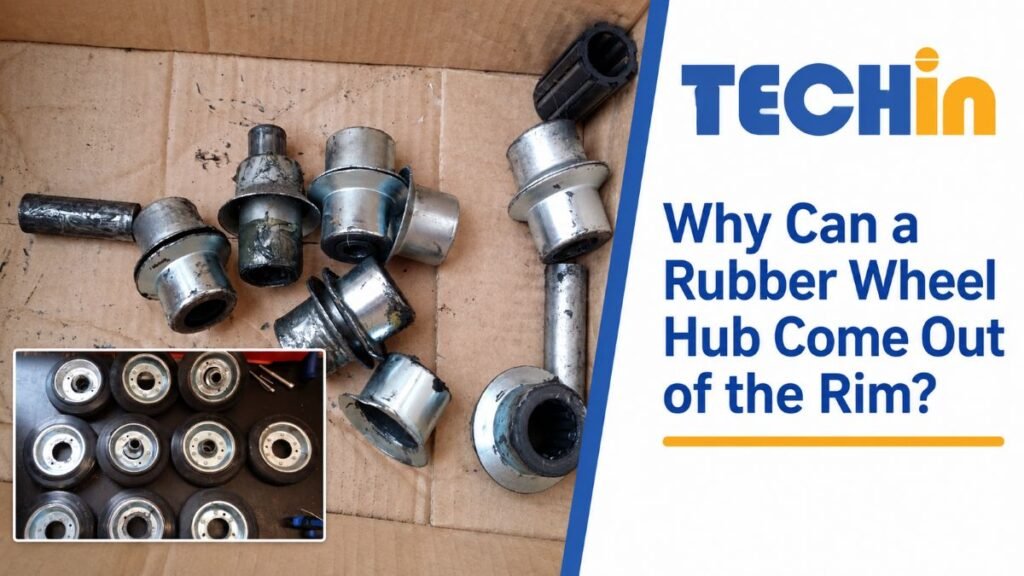
When a rubber wheel hub comes out of the rim, equipment can stop. The first task is to separate a product issue from an application issue.
A rubber wheel hub can come out when the hub-to-rim connection has insufficient retention, or when fit, bonding, geometry, load, or impact do not match the service condition. The visible separation alone cannot identify the initiating path; supplier and buyer should compare the relevant evidence together.
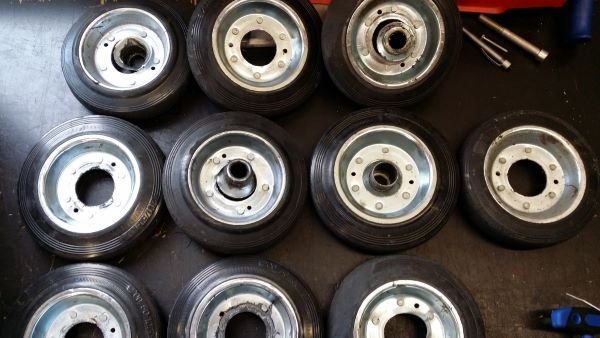
Separated hub and rim components are visible in the supplied case photograph.
A customer contacted Techin Castor after the metal hub came out of a large rubber wheel’s rim. Photos showed assemblies in different conditions and separate hubs, axles and rims. Techin Castor requested load, working environment, and installation details because they affect interface forces. A limited stock check did not reproduce the issue under that setup. That result does not resolve the mechanism. The next step is a joint supplier-buyer investigation using failed parts, measured interface data, and agreed service conditions.
Why Can a Rubber Wheel Hub Come Out of the Rim?
The hub is the metal centre that carries the axle or bearing. The rim is the wheel body around it. If the connection loses enough retention, the hub can move or pull free. This does not show whether the starting weakness came from fit, bonding, deformation, or service conditions.
| Visible pattern | Possible path to examine | First useful check |
|---|---|---|
| Hub appears pulled out with little rubber damage | Interface fit or retention | Measure mating diameters and seating position before further disassembly |
| Rubber is torn or peeled around the metal | Rubber-to-metal bonding or moulding | Inspect the bonded area and compare the tear pattern with an approved sample |
| Hub or rim looks bent, oval, or uneven | Deformation or eccentric loading | Check roundness, concentricity, and side-load conditions |
| Cracks or tears appear with impact marks | Shock or overload contribution | Compare actual load, speed, floor, and obstacles with the design condition |
These are screening clues, not a root-cause verdict. Preserve failed parts before cleaning or pressing them apart; contact marks and tear direction can be lost.
What should a supplier measure before approving a rubber wheel?
Ask for records that connect the separated hub to a measurable property. Request:
- Which hub and rim dimensions and tolerances define the fit?
- What retains the hub: interference, a mechanical feature, a rubber bond, or a combination?
- What minimum pull-out or retention force applies to this design, and which load case sets it?
- How are concentricity, seating, deformation, cracks, and bonded area checked?
- How are failed, approved, and production samples compared?
- Which service conditions must be declared before the supplier confirms the design?
The supplier’s answer should contain measured values and a pass or fail rule, not only a statement that samples ran normally. Without a defined retention property, the same ambiguity remains in future buying decisions.
How should buyers test a rubber wheel under load and impact?
Use the agreed application conditions, inspect the interface with the supplier, and then test the suspected property. This joint sequence keeps a visible symptom from becoming an unsupported conclusion.
- Confirm the application together. Record load per wheel, supporting wheels, speed, floor condition, ramps or obstacles, turning, impact, duty cycle, and mounting method.
- Compare interface data. Check critical diameters, seating depth, axial position, roundness, deformation, and concentricity against the supplier’s approved values.
- Inspect the rubber and metal contact. Look for cohesive rubber tear, a clean release surface, incomplete fill, voids, or marks that show movement.
- Check retention separately. Use a controlled pull-out or retention test on failed and approved comparison samples. Define the fixture, loading direction, speed, and pass condition before testing.
Where rubber contributes to retaining the metal, ASTM D429 covers static adhesion testing of rubber to rigid metal substrates and allows comparative production-part testing when the design permits. [1]
Do not copy a retention force from another wheel design. Agree the minimum value from the actual load cases, interface geometry, and intended application.
How can buyers separate rubber wheel service load from product evidence?
A useful supplier-buyer test reproduces service forces, not only free running on a bench.
Define these conditions before testing:
- Load: State the load per wheel and allowance for uneven distribution.
- Motion: Record speed, direction, turning, and start-stop operation.
- Surface: Describe the floor, joints, ramps, obstacles, and edge transitions.
- Impact: Define the obstacle or impact condition that represents service use.
- Duration: Set cycles or distance, rest periods, and relevant temperature conditions.
- Pass condition: State the limits for hub movement, separation, cracking, permanent deformation, and wheel function.
The ISO 22878 test-method standard covers methods and apparatus for checking castor and wheel performance. [2] Use it as a framework, then adapt the setup to the wheel and application.
Industry guidance from ICWM treats load capacity and vertical impact as separate considerations. [3] Add a post-test retention check and inspect the hub/rim interface after running and impact.
A short test with no defined load, cycles, or acceptance criteria can show only non-recurrence under that setup. It cannot confirm secure service retention.
Conclusion
Rubber wheel hubs can come out when fit, bonding, geometry, or service loading do not match. Preserve failed parts, measure the interface, agree retention criteria, and test realistic impact.
Related Reading
- ASTM D429 rubber-to-metal adhesion methods
- ISO 22878 castor and wheel test methods
- ICWM load and impact guidance
References
- ASTM International, Standard Test Methods for Rubber Property—Adhesion to Rigid Substrates D429.
- International Organization for Standardization, ISO 22878:2004 Castors and wheels — Test methods and apparatus.
- ICWM, Load and impact guidance for castors and wheels.