
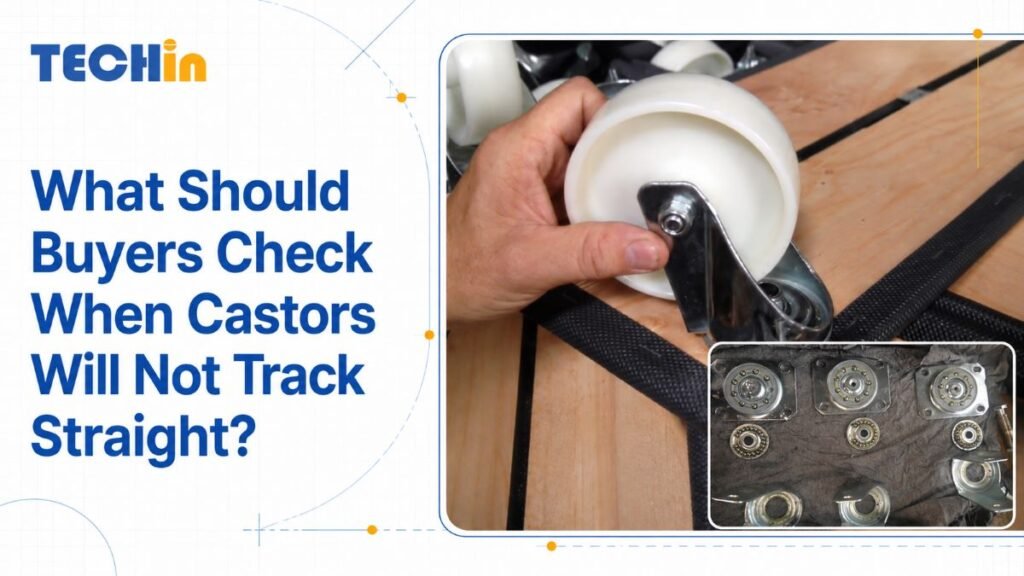
A trolley that pulls left or right wastes operator effort and can hide a castor problem until the load or floor changes.
Check swivel resistance and play first, then wheel-bearing play, wheel runout, mounting, load distribution, and floor conditions. Test the complete trolley under empty and working load before bulk approval.
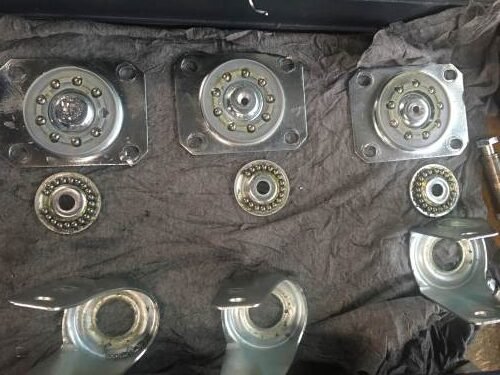
Opened swivel assemblies show visible differences in ball arrangement.
A customer contacted us after trolleys fitted with industrial castors became difficult to move straight. The customer reported movement to either side, occasional hooking, and heavy steering. We reviewed the reported samples and comparison evidence. The material pointed to more than grease alone, so the practical lesson is to isolate each movement interface before changing a castor specification.
How Can Buyers Separate Swivel Drag From Wheel Resistance?
A hand check can show that a castor feels wrong, but it cannot identify which rotating interface creates the resistance.
Hold the wheel and axle steady while checking the mounting plate against the housing. Then check wheel rotation separately. This separates swivel drag from wheel or axle resistance. Use ISO 22878:2004 as a recognised test-method reference, then agree product-specific limits for the application.[1]
A swivel castor has two different rotating paths. The swivel bearing turns the housing around the mounting plate. The wheel bearing or bush lets the wheel turn around its axle. A problem in one path can feel similar to a problem in the other.
| Observation | First check | What it may indicate |
|---|---|---|
| The wheel rolls freely, but the housing resists turning | Swivel resistance, play, grease, clearance, and riveting condition | Drag or looseness in the swivel assembly |
| The housing turns, but the wheel is hard to rotate | Wheel bearing, axle, hub fit, and contamination | Wheel-side resistance or an axle interface problem |
| Bench checks seem acceptable, but the trolley pulls sideways | Runout, mounting, load distribution, floor, and castor layout | A complete-assembly or application effect |
| The symptom changes with temperature | Grease behaviour and the same mechanical checks at the relevant temperature | Temperature-sensitive resistance, not proof of a grease-only cause |
Do not tighten the axle to correct swivel play. Do not change grease before checking whether the wheel, housing, and mounting move independently.
Which Castor Measurements Affect Straight Tracking?
Straight tracking depends on repeatable geometry and movement, not on a single hand-feel judgement.
MHI’s ICWM guidance treats swivel play as a castor performance characteristic. Measure the movement at the swivel assembly separately from wheel or axle movement, and record the test condition beside every result.[2]
Use these checks as a minimum comparison set:
- Swivel play: Measure movement between the fixed mounting plate and the swivelling housing or fork. Record the fixture, reference point, applied condition, and result.
- Wheel-bearing play: Hold the housing steady and check movement at the wheel and axle. Record the direction and location of the movement.
- Wheel runout: Check whether the wheel or tread moves off-centre during rotation. Compare the same point and method across samples.
- Mounting condition: Check plate flatness, hole fit, bolt seating, and the mating frame. A castor can appear defective when the mounting surface distorts the housing.
- Load distribution: Confirm that each castor carries the intended share of the trolley load. Uneven loading can make one castor steer or roll differently.
The case comparison showed why this separation matters. It recorded differences in swivel play, wheel-bearing play, and wheel runout, while the opened swivel assemblies showed visible ball-configuration variation. Those findings support a diagnostic route, but they do not create a universal acceptance limit for every industrial castor.
How Should Buyers Test a Loaded Trolley?
A bench check is useful, but it cannot reproduce the frame, load, floor, and mounting conditions that control real tracking.
Test the castor first, then test the complete trolley with the intended castor arrangement. Measure both the castor and the complete trolley under the application conditions.
Use a staged test:
- Set the route. Use a defined, reasonably level floor and record the travel direction, distance, and surface condition.
- Define the load. Test the empty trolley if it is moved empty, then repeat with the normal working load. Keep the load position consistent.
- Check each castor. Record swivel movement, wheel rotation, play, runout, and any hooking or binding before the trolley test.
- Run the complete trolley. Push it in both directions over the defined route. Record drift, steering corrections, wheel marks, and any change under load.
- Repeat relevant conditions. If the application sees temperature changes, repeat the test at the agreed temperature. SKF’s grease selection guidance explains why low-temperature limits and frictional torque matter when grease is part of the specification.[3]
- Compare with the reference. Use the same castor arrangement, conditions, and approved reference sample for every comparison.
The pass condition should be written before testing. It may define the maximum drift over a stated route, the permitted steering correction, the allowed play or runout, or a combination of these. The correct values belong to the application and castor design, not to an invented universal number.
What Should a Supplier Record Before Bulk Approval?
A useful supplier report links the castor measurement to the complete-trolley result.
Ask the supplier to record:
- castor type, wheel diameter, tread width, wheel material, bearing, and fitting;
- swivel construction, grease specification, and controlled application condition;
- swivel play and wheel or axle play as separate results;
- wheel runout and the measurement method;
- mounting surface, fixing condition, load, floor, speed, and travel direction;
- sample identity, reference sample, equipment, and pass or fail decision;
- complete-trolley results under the agreed empty and working-load conditions.
A practical supplier question is: “Can you show separate swivel, wheel, and complete-trolley results using the same reference castor and the same load condition?” That question turns “the castor feels acceptable” into a result that purchasing and quality teams can compare.
Conclusion
Buyers should isolate swivel resistance, play, wheel-bearing condition, runout, mounting, load, and floor effects, then approve the complete trolley against written limits and a reference castor.
Related Reading
References
- International Organization for Standardization, ISO 22878:2004 – Castors and wheels – Test methods and apparatus.
- MHI ICWM, Key Factors when Specifying Casters.
- SKF, Selecting a suitable grease.