
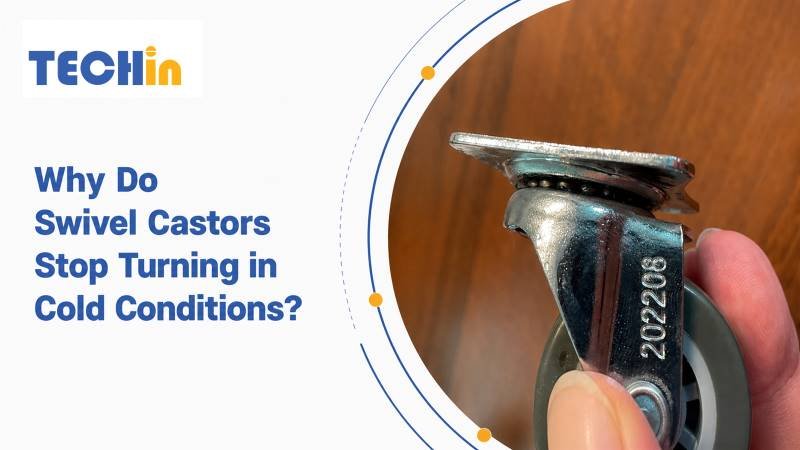
A swivel castor can still roll forward while its top plate will not turn. That distinction matters when a trolley becomes difficult to steer.
A swivel castor stops swivelling when cold or contaminated grease creates drag in the swivel bearing, or when clearance and preload are too tight. Buyers should test swivel action separately from wheel rolling.
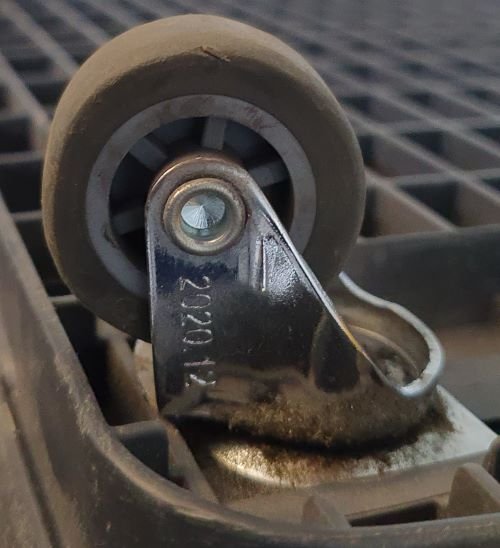
Close view of the swivel castor for shopping basket trolleys
A customer contacted Techin Castor after the swivel castors on small plastic shopping basket trolleys stopped swivelling smoothly. The customer reported grease escaping from the swivel bearing area, absorbing dust, and contributing to hooking or blockage. The customer also specified lithium grease for a -20°C to +40°C range and made clear that an empty basket still had to move freely. We reviewed side-by-side samples and the reported cold-condition comparison. An improved sample was later checked and accepted as the production reference. The buyer lesson is clear: swivel movement must be tested separately from wheel rolling, not inferred from a grease label alone.
What happens to swivel castor grease in the cold?
Grease is not simply a liquid that stays the same at every temperature. Its base oil, thickener, consistency, and oil-release behaviour affect the resistance felt when a swivel bearing starts moving. SKF’s grease lubrication guidance explains that operating temperature, grease quantity, consistency, and oil bleed must be considered together.[1]
At low temperature, grease can become more resistant to movement. That raises starting torque, so the swivel castor may hesitate even though the wheel itself still rolls.
This is why a specification such as “lithium grease, -20°C to +40°C” is useful but incomplete. The buyer should also confirm the grease grade or consistency, compatibility with the bearing and seals, controlled application quantity, and the actual cold-condition swivel result. A chemical operating range is not the same as a proven low temperature start-up result in a complete castor.
How can grease leakage restrict swivel movement?
Grease at the swivel bearing should lubricate and protect the swivel assembly. If too much grease migrates out, it can carry or collect dust. The resulting paste may increase drag, create a gritty feel, or make the swivel movement hook at a particular position. SKF notes that excessive grease can contribute to leakage and resistance, so quantity deserves the same attention as grease selection.[1]
Cold grease is only one possible contributor. Tight riveting, insufficient running clearance, bearing preload, a distorted top plate, or an uneven mating surface can also increase resistance. The practical diagnostic question is whether swivel movement is stiff only when cold, hooks after grease contamination, or has geometric play and tilting. The wheel can still roll in each of these conditions. Those observations lead to different corrective actions.
| Observation | First buyer check | What to record |
|---|---|---|
| Swivel castor becomes stiff after cold conditioning | Repeat the same top-plate swivel movement with the same load after controlled conditioning | Conditioning temperature, load, and swivel result |
| Grease is visible outside the swivel head with dust attached | Check the specified grease, consistency, compatibility, and application control | Leakage and contamination observations |
| Wheel rolls but the top plate will not swivel | Check the swivel bearing, clearance, riveting, and complete movement path | Where the hook occurs and whether it repeats |
| The top plate tilts or the castor has excessive play | Compare plate flatness and play with the drawing or approved sample | Measured value against the agreed acceptance limit |
Which swivel castor checks should buyers run?
Use a staged test that separates swivel movement from wheel rolling, temperature, load, contamination, and geometry effects:
- Establish a room-temperature baseline with the castor fitted to the intended basket or trolley. Check empty movement first, then the normal working load.
- Condition the complete castor and mating assembly at the agreed application lower limit. If the requirement is -20°C, test at that limit or at another documented point that represents the real use condition.
- Check top-plate swivel start-up and movement through its working range. Separately check that the wheel rolls freely. A rolling wheel does not prove that the swivel castor is free to turn. Look for grease leakage or visible contamination after the test.
- Repeat the check on the actual trolley or basket. A loose bench check can miss mounting-surface, alignment, and load effects.
- Compare the result with the approved sample and the written acceptance criteria. Do not replace a functional result with a grease name or a room-temperature hand check.
A published castor inspection procedure uses the same useful pattern: check free swivel movement, separately confirm wheel rotation, and perform a loaded drive test.[2] The exact load, temperature, conditioning time, and pass limits should come from the buyer’s application rather than being invented as a universal castor tolerance.
What should buyers specify for swivel castor movement?
Write the requirement so that a supplier can select and verify the whole castor, not only one material:
- Lubrication: name the grease type or grade, consistency, operating range, compatibility requirements, and controlled application quantity.
- Function: define cold start-up and top-plate swivel-movement checks for empty, light, and normal working conditions where those states matter. Record wheel rolling separately.
- Cleanliness: require no external grease condition that can attract dust and cause visible drag or hooking.
- Geometry: set acceptable swivel play, plate flatness, mounting-hole fit, and running clearance against the drawing or approved sample. AVO’s fitting guidance explains why a castor top plate needs a flat mounting surface and matching dimensions.[3]
- Reference sample: identify the approved castor configuration and use the same reference for first-article and ongoing functional checks.
Conclusion
Reliable swivel movement comes from compatible grease, controlled quantity, correct clearance, clean assembly, and a complete low-temperature test. Put each point in the specification before bulk approval.
Related Reading
References
- SKF, Grease lubrication.
- HMI-Basen, Inspect Castors.
- AVO, Types of fittings.