Skip to content
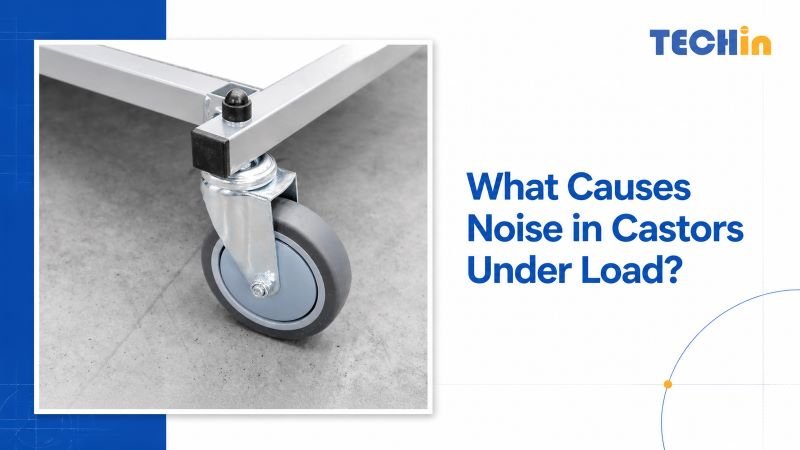
Castor noise that appears only when equipment is loaded is easy to misdiagnose. A quiet hand-spin can hide movement, rubbing, or distortion that changes under working force.
Noise under load usually comes from a change in wheel, axle, hub, fork, tread, floor, or clamping condition. Buyers should compare the complete castor under a defined load, speed, floor, and sound-recording method, then separate wheel play from swivel play.
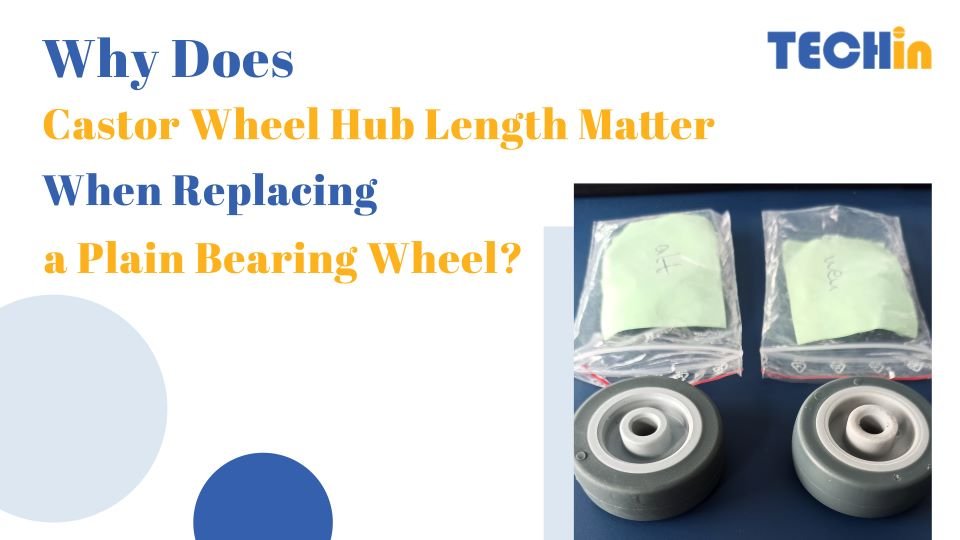
A customer contacted us after two fixed TPR castor samples produced different rolling sounds. The customer also saw different movement when comparing the samples under working conditions. We reviewed the videos, checked the visible assembly behaviour, and compared the axle-tube, axle-hole, and hub dimensions. The comparison showed why an unloaded hand-spin cannot answer the full question.
Why can a castor sound different under load?
Load changes the forces and clearances inside the complete castor. Several mechanisms can therefore create a different sound without one dimension proving the cause.
- The wheel tread can deform and change its contact with the floor.
- Wheel, hub, or axle movement can allow rubbing, clicking, or intermittent contact.
- The axle tube, hub length, fork width, washers, and hub caps form an axial-clearance stack.
- Bearing condition, contamination, or uneven clamping can add resistance and vibration.
- Floor texture, travel speed, direction, and equipment mounting can change the sound reaching the listener.
This is why a castor that sounds acceptable while lifted may sound different after it is fitted to equipment. The test condition is part of the result.
What did the case comparison show?
The customer’s comparison included two samples with different sounds and visible movement. The report recorded small differences across the axle tube, axle hole, and hub length. It also identified fork width, washer or hub-cap condition, axle-tube end faces, clamping, and measurement repeatability as relevant checks.
Those observations support a useful buyer lesson. Do not select one suspected dimension from a dismantled sample and treat it as the complete diagnosis. Check the finished castor in the same assembled condition in which it will work.
How do buyers separate wheel play from swivel play?
First identify where the movement occurs. Wheel or axle play is movement around the wheel, axle, hub, bush, or bearing. Swivel play is movement between a mounting plate and a swivelling housing. Mounting movement comes from the fixing or test fixture.
Hold the wheel and axle assembly steady while checking the housing if the castor is a swivel type. Then hold the housing steady while checking movement at the wheel and axle. Record the direction, reference point, assembly condition, and applied load. Do not use a swivel-play limit to judge wheel or axle movement.
Our castor play measurement guidance explains why these movements need separate checks. ISO 22878:2004 provides a recognised framework for castor and wheel performance test methods and apparatus.[1]
How should buyers run a loaded castor noise test?
Use the complete castor, not a loose wheel, for the approval comparison. The test should reproduce the important application conditions and keep them stable between samples.
- Fit the castor with the specified wheel, axle, washers, hub caps, fasteners, and mounting plate or equipment fixture.
- Define the load applied to the complete equipment or castor. State how the load is distributed and whether the test is unloaded, partly loaded, or at working load.
- Define the floor surface, travel speed, travel direction, distance, temperature, and starting condition.
- Record sound from the same microphone position or recording position. Keep the background condition consistent. A phone recording can show a difference, but it is not automatically a calibrated sound-pressure result.
- Check the wheel and housing during and after the run. Look for axial movement, rubbing, binding, tread damage, loose hardware, or a change in wheel rotation.
- Compare more than one sample and record the spread. A single quiet sample does not establish production consistency.
For relevant industrial applications up to 1.1 m/s, ISO 22883:2004 sets out technical requirements, dimensions, and testing requirements within its stated scope.[2] It does not create one universal noise limit for every castor, floor, load, or application. The buyer and supplier still need to agree the product-specific test condition and pass rule.
What should a supplier record before approval?
Ask for a test record that lets another person repeat the comparison. The minimum fields should include:
- complete castor configuration and mounting condition;
- sample identification and production stage;
- applied load and load distribution;
- floor, speed, direction, distance, and temperature;
- microphone or recording position and background condition;
- observed movement, rubbing, binding, or tread contact;
- wheel-play or swivel-play result, identified separately;
- the acceptance rule and final pass decision; and
- any post-test visual or dimensional finding.
The buyer should also check the finished assembly, not only loose-part certificates. Our finished castor inspection guidance describes why component dimensions and assembled function need separate checks.
Conclusion
Noise under load is a complete castor result. Separate wheel or axle play from swivel play, then test load, floor, speed, recording method, movement, and the agreed pass rule.
Related Reading
References
- International Organization for Standardization, ISO 22878:2004, Castors and wheels — Test methods and apparatus.
- International Organization for Standardization, ISO 22883:2004, Castors and wheels — Requirements for applications up to 1.1 m/s (4 km/h).