
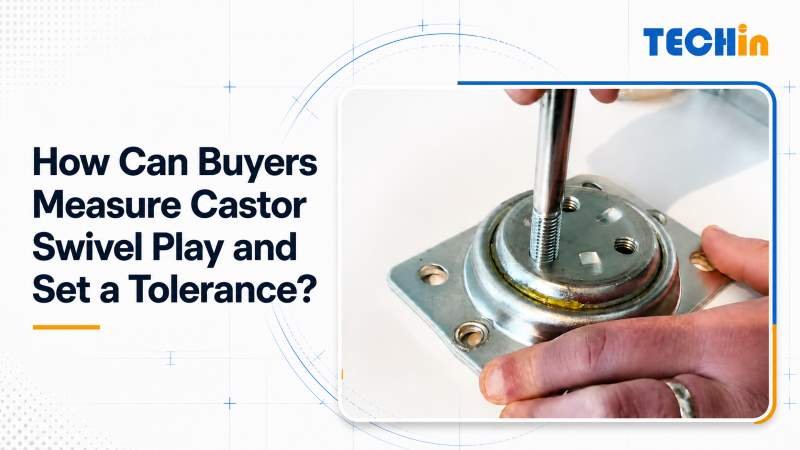
A loose castor can cause steering, noise, and quality concerns. The first step is to define exactly which movement is being measured.
Measure swivel play separately from wheel and axle play. Use one fixed test method, record the result at an agreed reference point, and set a product specific maximum.
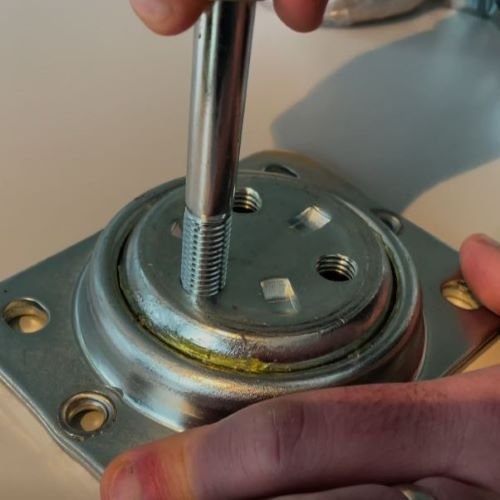
A secured plate swivel castor with a measurement lever and dial indicator for repeatable movement checks.
A customer contacted Techin Castor after an end user reported excessive play in a plate swivel castor. The customer shared a video and asked for the usual tolerance. The material showed movement, but no calibrated play value or approved product-specific limit was available. The practical need was therefore a repeatable measurement method and an agreed acceptance limit.
What Is Swivel Play in a Castor?
Swivel play is unwanted movement between the mounting plate and the swivelling housing or fork. It is different from movement at the wheel, axle, or fixing.
MHI’s ICWM guidance identifies swivel play as a castor performance characteristic because excessive movement can affect steering, ergonomics, and operator safety.[1]
Before testing, identify the movement:
- Swivel play: movement between the fixed mounting plate and swivelling housing.
- Wheel or axle play: movement at the wheel, fork, axle, bush, or bearing.
- Mounting movement: movement caused by a loose fixing or test fixture.
These movements need different checks. Tightening an axle will not correct excessive swivel movement.
How Can Buyers Separate Swivel Play From Wheel Play?
Hold the wheel and axle assembly steady. Then check whether the movement is between the mounting plate and the swivelling housing.
| Movement | Where to observe it | Record |
|---|---|---|
| Swivel play | Mounting plate to swivelling housing | Movement at the agreed reference point |
| Wheel or axle play | Wheel, fork, axle, bush, or bearing | Direction and local movement |
| Mounting movement | Castor to fixture | Fixing and fixture condition |
ISO 22878 separates wheel-play and swivel-play tests. Its wheel-play method excludes side movement of the wheel on the axle, while its swivel method measures movement at the swivel assembly.[2]
How Should Buyers Measure Castor Swivel Play?
Use the complete castor as supplied. Secure the fork or housing while allowing the swivel to move freely, then compare the readings from the defined positions.
An ISO 22878:2004 test preview provides a repeatable reference method. It uses a lever fixed to the mounting plane, measures movement at a defined distance from the swivel axis, and compares positions around 90 degrees apart. The larger reading is recorded.[3]
For a buyer-supplier test, define these four points in advance:
- Fixture: how the castor is restrained without restricting swivel movement.
- Reference: the measurement point or lever distance from the swivel axis.
- Result: the unit, movement direction, applied load or force, and reading method.
- Stage: whether the requirement covers initial play, final play after a defined sequence, or both.
The standard gives a test structure; it does not set one universal tolerance for every castor design, load rating, or application.
How Should Buyers Set a Castor Swivel-Play Tolerance?
Do not copy a limit from another castor family. Furniture, industrial, and heavy-duty castors can have different bearing designs, loads, and functional requirements.
| Specification field | What to define |
|---|---|
| Movement and condition | Swivel play, complete castor, fixture, posture, and applied load |
| Reference and result | Measurement distance, unit, direction, and maximum reading |
| Test stage and limit | Initial or final play, plus the maximum acceptable value |
| Record | Sample identity, equipment, date, readings, and final result |
Set the limit from the application need and a repeatable baseline:
- Test representative samples with the same fixture and method.
- Record the spread between samples, not only the best result.
- Confirm which movement affects steering, stability, or service life.
- Agree the maximum value before production approval or shipment release.
The final limit belongs in the product specification. ISO 22878 provides a framework, but the buyer and supplier must agree the acceptance value in writing.
What Should Buyers Ask a Castor Supplier to Report?
Ask for the measurement conditions and readings, not only a statement that the castor is acceptable. The report should show:
- the movement tested;
- the sample and assembly condition;
- the fixture, reference distance, unit, and applied load or force;
- initial and final readings, where relevant; and
- equipment, date, acceptance limit, and final result.
This gives purchasing and quality teams a shared basis for comparing samples and investigating complaints.
Conclusion
Measure castor swivel play separately from wheel and axle play. Use a fixed reference method, record the test conditions and readings, and agree the maximum value before release.
Related Reading
References
- MHI, ICWM key factors when specifying castors.
- International Organization for Standardization, ISO 22878:2004 – Castors and wheels – Test methods and apparatus.
- International Organization for Standardization, ISO 22878:2004 test-method preview.