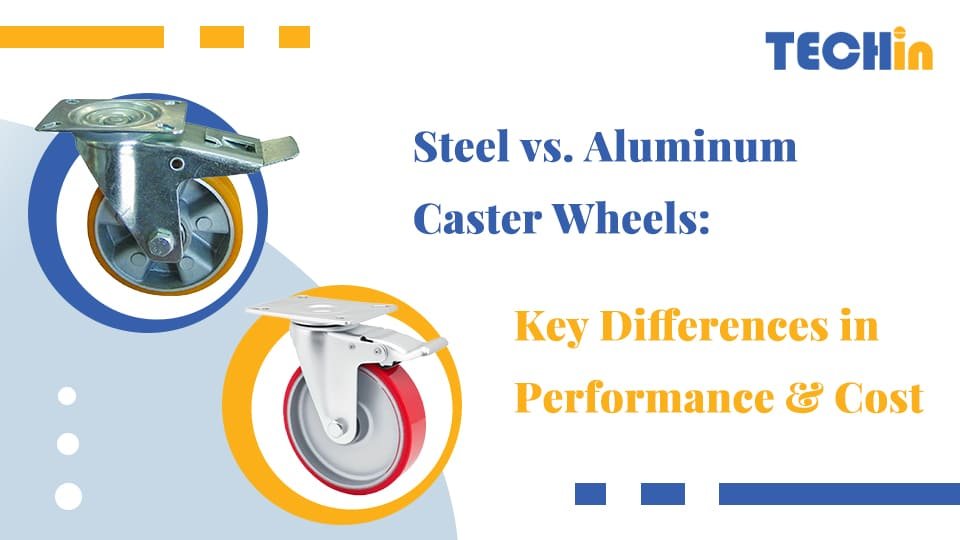
Struggling to choose the right caster material? A wrong decision can lead to high costs, frequent replacements, and even safety hazards on your factory floor.
The main difference is that steel casters offer superior strength for extreme loads at a lower cost, while aluminum casters are lightweight, corrosion-resistant, and better at dissipating heat. Your choice depends entirely on your specific application, environment, and budget.
Choosing between steel and aluminum isn’t just a simple preference. It’s a critical business decision that impacts your equipment’s efficiency, longevity, and your bottom line. I’ve seen many clients, from large distributors in Germany to factory owners in Italy, grapple with this choice. Let’s break down the details so you can make the best decision for your needs. We will look at what defines each type and how they stack up against each other in real-world applications.
What Exactly Are Steel Caster Wheels?
Confused about what makes a steel caster so tough? You see them everywhere on heavy equipment, but their simple appearance hides some key characteristics you need to know about.
Steel caster wheels have a core made from cast iron or forged steel. This makes them incredibly strong and durable. They are the go-to choice for handling extremely heavy loads in demanding industrial environments where sheer strength is the most important factor.
When we talk about steel caster wheels, we are really talking about the core of the wheel. The outer part is usually polyurethane or another material for smooth rolling. The inner part, the core, is made of very dense and strong metal, like cast iron. This is their main identity. Think of them as the powerlifters of the caster world. Their primary job is to bear immense weight without breaking or deforming. This makes them perfect for applications in heavy manufacturing, construction sites, and aerospace industries where equipment can weigh several tons. The trade-off for this incredible strength is weight. Steel is heavy, which can make the carts or equipment harder to start moving. But for static heavy loads or infrequent movement, their unmatched load-bearing capacity is exactly what you need.
And What About Aluminum Caster Wheels?
You might think aluminum is too soft for casters. But modern aluminum wheels are changing the game, offering a unique set of benefits that steel can’t match.
Aluminum caster wheels feature a core made from a high-strength aluminum alloy. They are significantly lighter than steel wheels, offer excellent resistance to rust and corrosion, and are great at dissipating heat, making them ideal for a wide range of modern applications.
Just like steel wheels, aluminum caster wheels have a metal core surrounded by a tread material. The key difference is the core is made from an aluminum alloy. Don’t mistake this for the soft aluminum of a soda can. These are engineered alloys designed for strength and durability. Their biggest advantage is being lightweight. An aluminum wheel can be 30% to 50% lighter than a steel wheel of the same size. This makes equipment much easier for workers to push and maneuver. It also means less wear and tear on your floors. On top of that, aluminum naturally forms a protective oxide layer, so it doesn’t rust. This makes it a fantastic choice for food processing plants, medical facilities, or any environment where moisture or chemicals are present. They are becoming more and more popular in logistics and automated systems.
What Are the Main Benefits of Using Steel Caster Wheels?
Your equipment is extremely heavy and you need a caster that will not fail. In this situation, you need to understand why steel has been the traditional choice for so long.
The main benefits of steel caster wheels are their massive load capacity, exceptional durability against impact, and a lower initial purchase price. They provide the raw strength needed for the most demanding heavy-duty jobs, ensuring reliability under extreme weight and rough conditions.
Let’s look deeper into why steel remains a top choice for specific applications. The benefits are clear and directly address the needs of heavy industry.
- Unmatched Load Capacity: Steel’s density and structural integrity mean it can handle loads that would crush other materials. We produce steel casters that are rated for several thousand kilograms. This is essential for moving large machinery, industrial containers, or automotive frames.
- Extreme Durability: Steel cores are highly resistant to shock and impact. In a busy workshop or on a construction site, casters are often banged into obstacles. A steel core can take this punishment without cracking or failing, extending the life of your equipment.
- Cost-Effectiveness: The raw materials and manufacturing process for cast iron are generally less expensive than for aluminum alloys. This makes steel casters a more budget-friendly option upfront, which is a key factor for many buyers, like my client Lenu in Italy.
| Benefit | Ideal Application | Why it Matters |
|---|---|---|
| High Load Capacity | Heavy Machinery, Aerospace | Prevents caster failure under extreme weight, ensuring safety. |
| Durability / Impact | Warehouses, Construction | Reduces replacement frequency and maintenance costs. |
| Lower Initial Cost | Budget-conscious Projects | Allows for lower initial investment in equipment. |
What Makes Aluminum Caster Wheels a Great Choice?
Your operations require frequent movement, clean environments, or high-speed use. Steel seems like overkill, and you’re worried about rust and worker fatigue. This is where aluminum shines.
Aluminum caster wheels are an excellent choice because they are lightweight, making equipment easier to move. They are also highly resistant to corrosion and dissipate heat effectively, which is perfect for continuous use and clean environments like hospitals or food processing plants.
The advantages of aluminum address the weaknesses of steel and open up new possibilities for efficiency and longevity. For a client like Hans in Germany, who values reliability and long-term performance, these benefits are very important.
- Lightweight & Ergonomic: Because they are up to 50% lighter, aluminum wheels make carts and racks much easier to push, pull, and steer. This reduces physical strain on employees, which can lead to fewer injuries and higher productivity. The lighter weight also means less inertia, so starting and stopping is easier.
- Superior Corrosion Resistance: Aluminum does not rust. This is a huge advantage in wet, humid, or wash-down environments. You don’t need to worry about rust contaminating products in a food or pharmaceutical facility. It also means the casters will last longer and look better over time with less maintenance.
- Excellent Heat Dissipation: In applications where wheels are rolling continuously, like on a towline in an automotive plant, heat can build up. Too much heat can melt the polyurethane tread. Aluminum’s ability to pull heat away from the tread keeps the wheel cool, extending its life significantly in high-speed or non-stop operations.
How Do Steel and Aluminum Caster Wheels Directly Compare?
You’re trying to decide, but you need a clear, side-by-side view. It’s hard to weigh the pros and cons without seeing all the facts laid out simply.
Here is a direct comparison: Steel offers higher load capacity and lower cost. Aluminum is lighter, resists rust, and handles heat better. The best choice depends on balancing these factors against your specific job requirements and environment.
Making the right choice means looking at the data. I’ve put together a table that summarizes the key differences based on my 20 years of experience in the caster industry. This is the kind of information my clients find most helpful when they are trying to optimize their purchases. Think about your own priorities as you look at this table. Are you more like Lenu, focused on budget and strength, or like Hans, focused on long-term performance and standards?
| Feature | Steel Caster Wheels | Aluminum Caster Wheels |
|---|---|---|
| Load Capacity | Very High to Extreme | Good to Very High |
| Weight | Heavy | Lightweight (30-50% lighter) |
| Corrosion Resistance | Poor (requires coating) | Excellent (naturally resistant) |
| Heat Dissipation | Poor | Excellent |
| Impact Resistance | Excellent | Good |
| Initial Cost | Lower | Higher |
| Best For | Extreme loads, rough use | Frequent movement, clean environments, high speed |
| Common Industries | Heavy Manufacturing, Construction | Logistics, Medical, Food Processing, Electronics |
As you can see, there is no single winner. A steel caster is the right tool for a heavy-duty job site. An aluminum caster is the right tool for a fast-paced, clean logistics center.
Are There Any Downsides to Steel Caster Wheels?
Steel casters sound incredibly strong, so what’s the catch? Before you decide that steel is the only option for heavy loads, you need to consider the potential problems.
Yes, the main disadvantages of steel caster wheels are their heavy weight, which makes equipment harder to move, and their susceptibility to rust. They also perform poorly in high-speed applications due to bad heat dissipation, which can damage the wheel tread.
While steel’s strength is its biggest asset, it also leads to its biggest drawbacks. First, the weight. A heavy steel caster adds significant weight to your cart or equipment. This means it requires more force to get moving and to stop, which can be a real issue for worker ergonomics and efficiency, especially if the equipment is moved often. Second, rust is a constant enemy. Unless they have a protective coating like zinc plating, steel cores will rust in damp or humid conditions. Once the coating is scratched or wears off, the rust begins. This not only looks bad but can also weaken the wheel over time and is unacceptable in industries like food and healthcare. Finally, steel holds onto heat. In a continuous-use application, like a towline, a steel core can get very hot, causing the polyurethane tread to soften or even melt off the core. This leads to premature wheel failure.
So, Which is Better: Aluminum or Steel Caster Wheels?
After all this information, you still need to make a final choice. You want a simple answer, but the reality is more nuanced and depends entirely on your situation.
Neither is universally “better.” Steel is better for extreme static loads and rough environments where cost is a primary concern. Aluminum is better for applications requiring easy movement, corrosion resistance, and high-speed performance. The best wheel is the one that fits your job.
Let me share a quick story. I have a long-time customer who always bought our heavy-duty steel-core casters for his projects. We suggested he try aluminum for some of his newer, more mobile equipment, but he was used to steel and trusted its strength. One day, he visited our factory in China. We were chatting, and I asked him as a joke, “Do you drive a car?” He said yes. I asked, “What are your car’s wheels made of?” He replied, “Aluminum alloy, of course.” So I asked, “If you think iron is always better, why not change your car’s wheels to solid iron?” He paused for a moment and then laughed. He suddenly understood. A car needs to be lightweight for performance and fuel efficiency, and it needs to handle heat from braking. The same logic applies to casters. After he went back to Italy, he called me and said he was ready to switch some of his orders to aluminum. The “better” choice always depends on the job the wheel has to do.
How Do I Choose the Right Caster Wheel for My Business?
You understand the differences, but how do you apply this to a real purchase order? You need a simple process to ensure you select the perfect caster every single time.
To choose the right caster, systematically evaluate your specific needs. Ask yourself about the load weight, the floor conditions, the environment, and how often the equipment will move. Matching the caster’s strengths to these answers ensures the best performance and value.
Choosing the right caster is a critical step. As a manufacturer, our goal is to help you find the perfect match, not just sell you a product. Here is a simple checklist of questions to ask yourself or your team before you place an order. This is the process we walk through with our clients to make sure they get exactly what they need.
- What is the maximum load? If it’s an extreme, multi-ton load with little movement, steel is a safe bet. For most industrial loads up to 1000 kg, high-quality aluminum is an excellent option.
- What is the environment like? Will the casters be exposed to water, chemicals, or frequent wash-downs? If yes, aluminum’s corrosion resistance is a major advantage. If it’s a dry, indoor environment, coated steel is fine.
- How often will it move? For equipment that is moved constantly throughout the day, the lightweight nature of aluminum reduces worker fatigue and makes handling much easier. For static equipment, the heavy weight of steel is not a problem.
- What is the speed of movement? Will the casters be used in a high-speed towline or automated system? If so, aluminum’s superior heat dissipation is essential to prevent wheel failure. For slow, manual speeds, steel is adequate.
- What is your budget? Steel has a lower initial cost. However, consider the total cost of ownership. Aluminum may last longer in certain environments and reduce labor strain, offering better long-term value.
Conclusion
Choosing between steel and aluminum casters depends on your needs. Steel offers maximum strength for heavy loads, while aluminum provides a lightweight, corrosion-resistant, and heat-dissipating solution for modern applications.