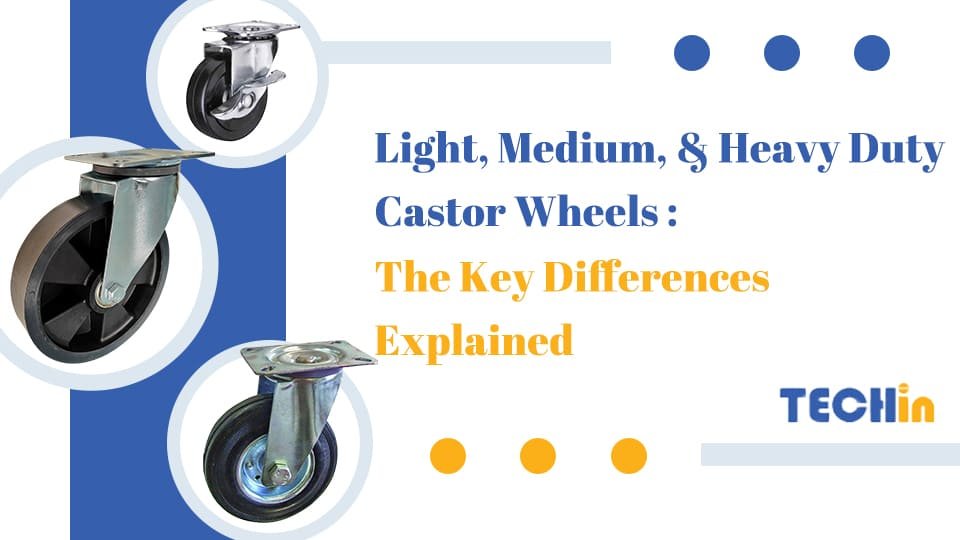
Choosing the wrong castor leads to damage and failure. This costs you money and time. Understanding duty ratings helps you pick the right castor for the job, every single time.
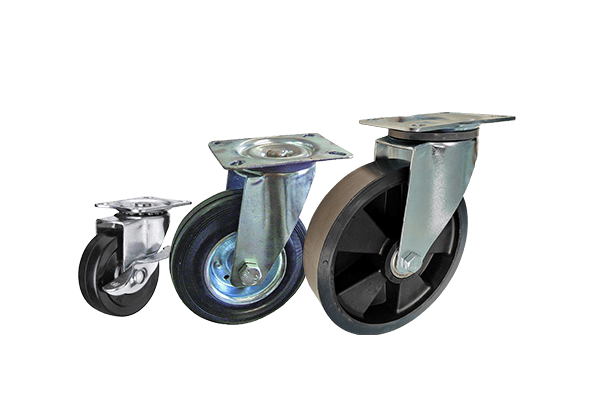
The key differences between light, medium, and heavy duty castors are their load capacity, housing construction, and intended application. Light duty castors have thin housings for furniture, while heavy duty ones use thick, welded steel for massive industrial loads. Medium duty castors bridge the gap for general factory use.
To make the best choice for your business, you need to know the details of each category. I have worked with castors for 20 years, and I see customers make mistakes here all the time. Let’s break down each type so you can choose with confidence.
What Are Light Duty Castors?
You need castors for office furniture or light equipment. A heavy industrial castor is too much, too expensive, and doesn’t look right. Light duty castors are the perfect solution.
Light duty castors are designed for lighter loads, typically from 10 kg to 140 kg per castor. They have thin steel housings (2-4mm) and are ideal for smooth floors in offices, hospitals, schools, and retail stores on items like chairs and display racks.
When we talk about light duty castors, we are talking about products built for maneuverability and aesthetics. They need to move easily and often look good, especially in commercial or office settings.
Applications
These are the castors you see every day. They are used on office chairs, store displays, supermarket trolleys, and medical equipment in hospitals. The key is that the loads are light and the floors are relatively clean and smooth. In our catalog, these fall under “Furniture Castors” and some “Apparatus Castors”.
Construction and Materials
The housing, or bracket, of a light duty castor is made from a thin steel sheet, usually 2mm to 4mm thick. We stamp it into shape, which makes it light and flexible. For the wheels, materials like Polypropylene (PP), Polyamide (PA, or Nylon), and Thermoplastic Rubber (TPR) are common. TPR is a great choice because it protects floors from marks and rolls quietly.
Load Capacity
A single light duty castor can typically handle a load between 10 kg and 140 kg. For example, a simple twin-wheel castor for an office chair might support 30 kg, while a larger apparatus castor can handle up to 140 kg.
What Are Medium Duty Castors?
Your factory carts move all day with moderate loads. Light duty castors break under this constant use, but heavy duty ones are too expensive. Medium duty castors are your solution.
Medium duty castors are the workhorses for industrial environments. They feature thicker steel housings (5-6mm) and are built for frequent use in factories and warehouses, handling loads from approximately 70 kg to 300 kg per castor, providing a balance of durability and cost.
Think of medium duty castors as the standard for general industrial applications. They are not for massive machinery, but they are much stronger than a simple furniture castor. They are built to withstand the bumps and constant movement of a busy workplace.
Common Uses
We supply these to factories and warehouses across Europe for material handling carts, workbenches, and medium-weight equipment. If a cart is being loaded and moved many times a day, this is the category you should be looking at. Our “Industrial Castors” section, like the I01 and I02 series, is filled with these options.
Robust Construction
The real difference is in the housing. We use a thicker steel plate, around 5mm to 6mm. These often feature duplex ball bearings in the swivel head, which makes them much more durable and able to withstand turning under load. The wheels are also more robust. Options include elastic rubber for quiet operation, or Polyurethane (PU) bonded to a cast iron or aluminum core for higher load capacity.
Load Capacity
The load capacity for medium duty castors bridges the gap between light and heavy. It starts around 70 kg and goes up to about 300 kg per castor. This wide range covers most of the general-purpose material handling needs in a typical industrial setting.
What Are Heavy Duty Castors?
You need to move a piece of heavy machinery. If a castor fails here, it is not just an inconvenience; it is a major safety risk and can cause expensive damage.
Heavy duty castors are engineered for the most demanding jobs, built to safely move very heavy loads from 200 kg to over 1200 kg per castor. They feature extremely thick, welded steel housings (8-12mm) and robust wheels for maximum strength and reliability.
When safety and strength are the top priorities, there is no substitute for a true heavy duty castor. I have seen what happens when an underrated castor is used for a heavy load, and the results are never good. These products are designed for pure performance under extreme stress.
Industrial Applications
These are for the toughest environments. Think machinery plants, textile mills, and aerospace workshops. They are used to move heavy workpieces, engine blocks, large equipment, and anything else where the weight is measured in tonnes, not kilograms. Our H01 and H02 series are designed specifically for these tasks.
Uncompromising Build Quality
The housing is the heart of a heavy duty castor. We make it from thick steel plate, from 8mm up to 12mm. Instead of just stamping, these housings are cut and welded for maximum strength. The swivel section uses a combination of ball bearings and flat thrust bearings to handle high vertical loads and side impacts. The wheels are also specialized, using materials like high-strength PA6 or PU chemically bonded to a solid cast iron core.
Load Capacity
Heavy duty castors start where medium duty castors stop. The load range begins around 200 kg and, for some of our specialized models, can go well beyond 1200 kg for a single castor.
What Are the Key Differences Between Light, Medium, & Heavy Duty Castors?
You know the different types, but telling them apart can still be tricky. Making a choice based only on wheel diameter or looks can lead to a very expensive mistake.
The primary differences are load capacity, housing thickness, and construction method. Light duty castors have thin, stamped housings for small loads. Heavy duty castors have thick, welded housings for massive loads. Medium duty fits in between for general industrial use.
To make it simple, I always tell my customers to look at three things: the housing, the load it needs to carry, and where it will be used. The specifications for each duty rating are very different because they are designed for completely different jobs. Let’s put them side-by-side. The housing thickness is one of the easiest ways to tell them apart. A light duty housing is thin and light, while a heavy duty housing is visibly thick and robust, often with obvious welds. This construction directly impacts how much weight it can safely bear.
| Feature | Light Duty | Medium Duty | Heavy Duty |
|---|---|---|---|
| Load Capacity | 10 – 140 kg | 70 – 300 kg | 200 – 1200+ kg |
| Housing Thickness | 2 – 4 mm | 5 – 6 mm | 8 – 12 mm |
| Housing Construction | Stamped Steel | Stamped & Welded | Welded Steel |
| Common Applications | Furniture, Retail, Medical | Factories, Warehouses | Heavy Machinery, Plants |
| Wheel Materials | PP, PA, TPR | Elastic Rubber, PU, PA | PU on Iron, Cast Iron, PA6 |
How Do You Choose Between Light, Medium, and Heavy Duty Castors?
You have the specifications, but you are still not sure which one to pick. Making the wrong choice means you waste money on a castor that is too strong or risk failure with one that is too weak.
First, you must calculate the required load capacity for each castor. Then, consider your floor conditions, the working environment, and frequency of use. This simple process will guide you to the correct duty rating and wheel material for your application.
As a manufacturer, my goal is to make sure you get a product that works for a long time. The best way I can do that is to help you choose correctly from the start. We can break the selection process down into two simple steps.
1. Calculate Your Load
This is the most important step. You need to know the maximum weight each castor will have to support. Don’t just guess. Take the total weight of your equipment, including the heaviest load it will ever carry, and use a formula to determine the required capacity per castor. We will cover this formula in the next section. Always choose a castor with a load rating that is higher than your calculated need.
2. Analyze Your Environment
Next, look at where the castor will be used.
- Floor Conditions: Is the floor smooth concrete, rough asphalt, or covered in debris? A hard wheel (like Nylon) is good for smooth floors, while a softer wheel (like rubber) is better for rough surfaces or protecting delicate floors.
- Environmental Factors: Will the castor be exposed to water, chemicals, grease, or extreme temperatures? Stainless steel housings are great for wet or hygienic areas. Certain wheel materials resist chemicals better than others.
How Are Castor Wheels Rated and How Do You Calculate the Load?
You see load ratings in a catalog, but you are not sure how to apply them. Miscalculating the load is the fastest way to cause a castor to break, leading to a failed project and safety risks.
Castors are rated by the maximum weight each can safely support. To calculate your need, add the equipment weight to its max load, divide by the number of castors, and add a safety factor. This ensures reliability even on imperfect floors.
This is a question I get from almost every new client, from big distributors in Germany to buyers in Italy. They want to know that our ratings are reliable and how to use them.
The Manufacturer’s Rating
We rate our castors based on their tested maximum static load capacity. This is the weight one castor can support without failing or deforming. In Europe, this is usually stated in kilograms (kg). In the US, it is often in pounds (lbs). The conversion is simple: 1 kg is equal to about 2.2 lbs.
The Safe Load Calculation
The catalog rating is a starting point. You must apply a safety factor to account for real-world conditions. I always recommend one of two formulas to my clients.
- For Smooth, Even Floors:
Load per Castor = (Weight of Equipment + Max Load) ÷ Number of Castors Used x 1.2
The 1.2 is a small safety factor. It adds 20% to the required capacity to handle small bumps and dynamic forces. - For Uneven Floors (The Safest Method):
Load per Castor = (Weight of Equipment + Max Load) ÷ 3
Why divide by 3, even if you are using 4 castors? Because on an uneven surface, one wheel can lift off the ground, forcing the other three to carry the entire weight. This simple formula automatically builds in a large, reliable safety factor. It is the method I recommend most often.
Conclusion
Choosing the right castor comes down to load, construction, and application. By matching the duty rating to your needs, you ensure safety, durability, and get the best long-term value.