Static electricity can destroy sensitive electronics in an instant. A simple cart movement could damage expensive components, leading to costly downtime. Anti-static castors are the simple solution to this invisible threat.
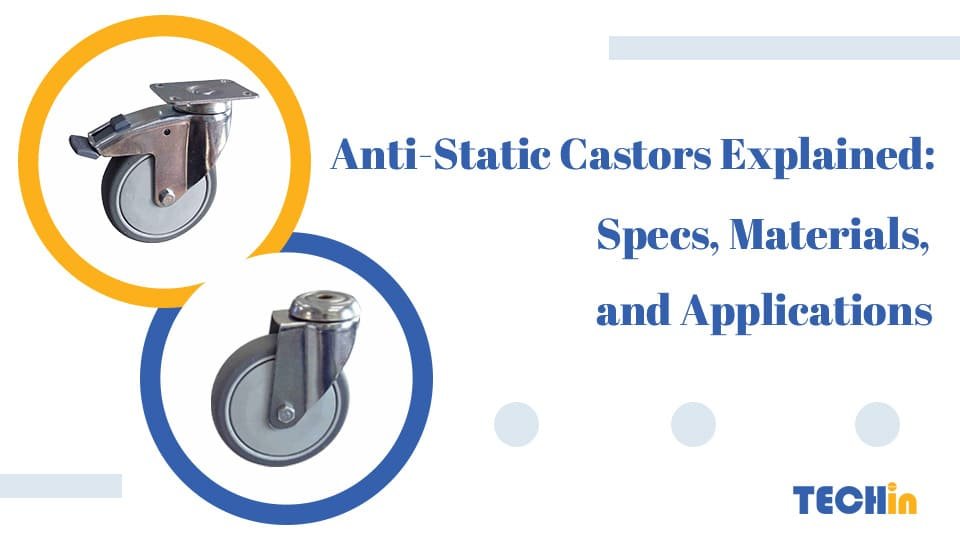
Anti-static castors are specialized wheels designed to safely dissipate static electricity. According to the ISO 22877 standard, a castor is considered anti-static if its electrical resistance is greater than 10^5 Ω but less than 10^7 Ω, preventing damage to sensitive electronic equipment.
In my 20 years in the castor industry, I’ve seen firsthand how a small component like a castor can make a huge difference in a high-tech manufacturing environment. For one of my client from Germany, who manages purchasing for a material handling equipment manufacturer, specifying the correct castor isn’t just about movement; it’s about protecting the final product. Choosing the right anti-static castor is a critical decision that impacts safety, product quality, and the bottom line. Let’s dive deeper into what makes these components so essential.
What are Anti-Static Castors?
You hear the term “anti-static,” but what does it really mean for a castor? Choosing the wrong type could lead to catastrophic equipment failure. Understanding their specific properties is the first step to making an informed choice.
An anti-static castor is a wheel engineered to prevent the buildup of static electricity. It has an electrical resistance between 100,000 ohms (10^5 Ω) and 10,000,000 ohms (10^7 Ω). This specific range allows static charges to dissipate to the ground in a slow, controlled manner.
When equipment on regular castors moves, the friction between the wheels and the floor generates a static charge, a process known as the triboelectric effect. This charge can remain on the cart until it finds a path to the ground, often through a sensitive electronic component. An anti-static castor provides a safe, continuous path for this electrical charge to flow away before it can accumulate to dangerous levels. This is crucial in environments where electrostatic discharge (ESD) can damage microchips, circuit boards, or other sensitive electronics. The international standard ISO 22877 helps define these properties, ensuring that castors sold as “anti-static” meet specific performance criteria for safely managing static electricity.
What are the advantages of Anti-Static Castors?
Standard castors offer no protection for your sensitive electronics. A single, unseen static discharge can cause immediate or latent damage, leading to expensive failures down the line. Anti-static castors provide critical protection and other key benefits.
The primary advantage is the protection of sensitive electronic components from electrostatic discharge (ESD). They also improve workplace safety by preventing sparks in environments with flammable materials and enhance cleanliness by not attracting dust particles.
For a business to run smoothly, especially in high-tech sectors, every detail matters. The advantages of using anti-static castors extend beyond simple movement. I have worked with clients who initially overlooked this, only to face mysterious equipment failures. Adopting the right castors solved their problems. Here’s a breakdown of the key benefits:
| Advantage | Description |
|---|---|
| ESD Protection | The most critical benefit is safeguarding sensitive electronics like microchips and circuit boards from damage caused by static discharge. This prevents product defects and costly repairs. |
| Enhanced Safety | In environments with flammable gases, solvents, or dust, a static spark can lead to a fire or explosion. Anti-static castors mitigate this risk by preventing spark-generating discharges. |
| Improved Cleanliness | Static charges attract dust and other airborne particles. By eliminating static buildup, these castors help maintain cleaner environments, which is essential in cleanrooms, laboratories, and medical facilities. |
| Increased Reliability | Even small static charges can interfere with the performance of sensitive manufacturing and testing equipment, causing glitches or errors. Anti-static castors ensure equipment operates reliably, leading to higher product quality. |
What are the uses of Anti-Static Castors?
You need to move valuable equipment within a static-sensitive area. Using the wrong castors is a gamble that could result in thousands of dollars in damage. Knowing the specific applications where these castors are essential is key.
Anti-static castors are crucial in electronics manufacturing, laboratories, cleanrooms, medical facilities, and data centers. They are used on any mobile equipment, like carts or workbenches, that transports static-sensitive devices or is used in a static-controlled environment.
Over the years, we’ve supplied anti-static castors to a wide range of industries across Europe. Each one has a unique need, but the underlying requirement is the same: control static electricity. For a buyer like Lenu from Italy, who needs quality castors for medical apparatus, performance is non-negotiable. A failure isn’t just a defect; it could impact patient care. Here are some of the most common places you will find these specialized castors:
- Electronics & Semiconductor Manufacturing: This is the largest area of application. They are used on assembly line carts, testing units, and workstations to safely transport delicate components like circuit boards and microchips.
- Hospitals and Medical Facilities: Sensitive diagnostic and monitoring equipment can be damaged by ESD. Anti-static castors are used on medical carts, IV stands, and mobile workstations to protect this vital equipment.
- Laboratories and Cleanrooms: In research and development, maintaining a controlled environment is critical. These castors prevent static from interfering with precise instruments or compromising experiments.
- Data Centers: Servers and networking equipment are highly susceptible to ESD damage. Carts used for installation and maintenance must be equipped with anti-static castors.
- Automotive Industry: Modern vehicles are packed with electronics. These castors are used on assembly lines where electronic modules are installed.
What are the common materials of Anti-Static Castors?
You know you need anti-static castors, but they come in many materials. Choosing the wrong material can compromise performance, durability, or even damage your floors. Understanding the common materials helps you match the castor to the job.
Common anti-static castor materials include Thermoplastic Rubber (TPR), Polyurethane (PU), Rubber, and Nylon. These materials are specially formulated with conductive additives that allow them to safely dissipate static charges while offering different performance characteristics.
The material of the castor wheel is just as important as its anti-static property. It determines the load capacity, rolling ease, noise level, and floor protection. When I talk with clients, we spend a lot of time on this detail. A heavy-duty application in a German factory needs a different material than a lightweight cart in an Italian hospital. Here’s a comparison of the most common materials we offer:
What are Anti-Static Castors and Conductive Castors?
The terms “anti-static” and “conductive” sound interchangeable. Confusing them is a common mistake that can lead you to specify the wrong castor, creating a safety or performance risk for your application.
The key difference is their electrical resistance. Anti-static castors have a resistance of 10^5 to 10^7 ohms, which dissipates static slowly. Conductive castors have a much lower resistance, typically below 10^4 or 10^5 ohms, and discharge static almost instantly.
This is a critical distinction that I always clarify with customers. While both manage static electricity, they do it differently and are meant for different purposes. Using a conductive castor where an anti-static one is needed could cause a rapid discharge that damages an electronic component. Conversely, using an anti-static castor in a highly explosive atmosphere might not dissipate a charge fast enough to prevent a spark.
| Feature | Anti-Static Castors | Conductive Castors |
|---|---|---|
| Resistance Range | 10^5 Ω to 10^7 Ω | < 10^4 Ω or < 10^5 Ω |
| Discharge Speed | Slow and controlled | Fast and immediate |
| Primary Purpose | To protect sensitive electronic components from ESD damage. | To prevent sparks in potentially explosive environments (e.g., with flammable gases or powders). |
| Typical Use Case | Electronics assembly, data centers, medical device carts. | Chemical plants, munitions factories, solvent handling areas. |
How to choose the right Anti-Static Castors?
You’re ready to buy, but the options are overwhelming. Making the wrong choice means you could end up with a castor that doesn’t perform, fails under load, or doesn’t provide the static protection you need.
To choose the right anti-static castor, you must evaluate your specific needs. Consider the required load capacity, floor conditions, environmental factors like chemicals or cleanliness, and critically, the level of static protection your application demands.
As a manufacturer and supplier, my goal is to ensure my clients get exactly what they need. I walk them through a simple selection process to cover all the bases. Whether it’s a large order for a hardware distributor or a specific solution for an equipment manufacturer, the process is the same. It prevents mistakes and ensures the final product performs perfectly. Here are the key steps I recommend:
- Define the Load Capacity: Determine the total weight the cart will carry and divide it by the number of castors you’ll use (usually subtracting one for safety, as the load is rarely perfectly distributed). This gives you the required load capacity per castor.
- Analyze Floor Conditions: Are your floors smooth, rough, or littered with debris? A softer material like rubber or TPR is better for uneven surfaces and floor protection, while a harder material like polyurethane or nylon rolls more easily on smooth concrete.
- Assess the Environment: Will the castors be exposed to chemicals, high temperatures, or require frequent washdowns? Do you operate in a cleanroom? The castor material and bracket finish (e.g., stainless steel) must be compatible with your environment.
- Confirm Resistance Requirements: Do you need anti-static (10^5-10^7 Ω) to protect electronics, or conductive (<10^5 Ω) to prevent sparks? This is the most important technical specification.
- Check for Certification: Ensure the castors are tested and comply with relevant standards like ISO 22877. This guarantees their anti-static properties are reliable. As part of our quality control, we conduct a strict Electrical Resistance Performance Test before shipping.
How to maintain Anti-Static Castors?
- Regular Cleaning: Dirt, debris, and grease can build up on the wheel’s tread, acting as an insulator and breaking the path to the ground. Clean the wheels regularly with a brush and appropriate cleaning agents.
- Periodic Resistance Testing: The anti-static properties can degrade over time. It is crucial to periodically test the castors with an ohmmeter to verify their resistance is still within the required range (10^5-10^7 Ω). This is a critical quality control step.
- Inspect for Physical Damage: Check the wheels for flat spots or embedded debris. Inspect the bracket (the fork) for cracks or bends. Ensure the swivel action is smooth and the wheel axle is tight.
- Check Fasteners: Vibrations from movement can loosen the bolts that attach the castor to the equipment. Regularly check and tighten these fasteners to prevent accidents.
- Maintain Your Floors: The floor is part of the complete grounding circuit. Keeping floors clean and in good repair ensures the castors can do their job effectively.
Conclusion
Anti-static castors are a small but vital component for protecting sensitive electronics and ensuring safety. Choosing the right one requires understanding your load, environment, and specific resistance needs.