
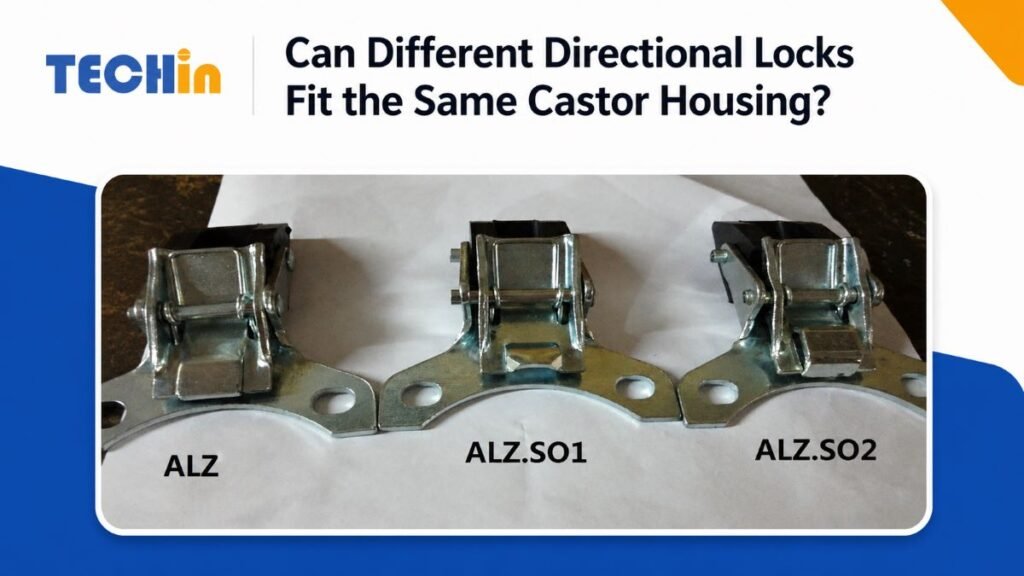
Similar-looking directional locks can fit different castor housings. A visual match may still leave the tongue, groove, or mounting height wrong.
Not reliably. Compare the lock profile, housing groove, mounting height, fixing pattern, and release movement before treating variants as interchangeable.
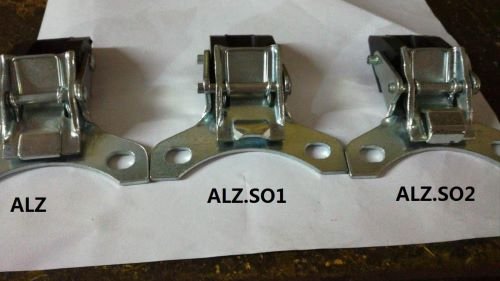
Visible differences in the front-end shapes of three directional-lock variants.
A customer contacted Techin Castor after one directional-lock version appeared to fit one transport-castor housing but slid past the fork on other sizes. We reviewed a side-by-side comparison and checked the housing interface. The customer feedback showed that similar-looking locks should be compared by engagement geometry, not appearance alone. An improved version was later accepted for future supply after the fit was reviewed.
Why Do Similar Castor Locks Have Different Shapes?
Similar parts can serve different housings because the locking tongue, the projecting engagement feature, must meet a specific receiving groove.
The front-end bend, depth, and position control how far the lock enters and how the swivel housing stops. A small shape difference can therefore change whether the lock seats, slides over the fork, or releases cleanly.
Manufacturers also list directional locks by housing family, wheel range, top-plate size, and slot arrangement. Tellure Rôta’s directional-lock guide shows this model-specific approach.[1]
When comparing variants, buyers should check:
- Lock profile: Compare the tongue or nose position, bend, depth, and contact face.
- Receiving groove: Confirm that the housing groove or slot is in the matching position and has enough space for full engagement.
- Mounting height: Check the lock, top plate, housing, and any ring or spacer as one height stack.
- Operating stroke: Confirm that the lock can engage fully and release without catching.
Which Housing Details Must Match?
Match the complete interface, not only the lock body or mounting plate. Use these five checks before calling a variant compatible.
Blickle’s technical guide lists separate directional-lock solutions for several castor constructions and series, including pressed-steel, welded-steel, heavy-duty, and synthetic castors.[2] This supports a useful sourcing rule: compatibility belongs to a defined product combination.
- Variant identity: Record the exact lock version and the castor or housing series.
- Housing or fork geometry: Record the receiving groove, slot, stop surface, and available clearance.
- Mounting relationship: Record plate size, fixing positions, lock height, and any ring or spacer requirement.
- Function: Define what locked, released, aligned, and fully seated mean for the complete castor.
- Application range: List every housing size and configuration covered by the approval.
These five checks prevent a close-looking component from being treated as a direct replacement.
How Can Buyers Control Castor Variant Substitution?
Substitution becomes risky when the original compatibility record names only a broad castor family. Use this three-step control:
- Compare: Record the lock profile, housing groove, mounting height, fixing pattern, and approved sizes.
- Check fit: Try the complete castor assembly with one approved sample. Repeat the check when the lock, housing, ring, plate, or forming shape changes.
- Approve: Mark the accepted combination in purchasing and assembly documents. Release a substitute only after it passes the complete-assembly check.
The supplied comparison photograph is useful because it makes the first warning visible: the three front-end shapes are not identical. It does not provide dimensions, so it should support comparison rather than replace a drawing or functional test.
What Should Buyers Test Before Approving a Castor Lock?
Use this four-step test on every housing size and configuration that the buyer intends to use:
- Assemble: Fit the candidate lock to the complete castor.
- Engage and release: Confirm full seating, correct directional hold, clean release, and free swivel movement when released.
- Repeat: Run the same check for every approved variant and size.
- Record: Note the housing, lock version, mounting arrangement, result, and any visible gap or sliding.
ISO 22878:2004 provides an official research path for castor and wheel test methods and apparatus.[3] Buyers should still agree the product-specific pass condition before testing. For a directional lock, that condition should cover full engagement, controlled release, correct alignment, and repeatable behaviour across the approved combinations.
Conclusion
Do not approve a directional-lock substitute by appearance. Compare its profile, groove, height, fixing, and release, then test the complete castor assembly.
Related Reading
- Tellure Rôta directional-lock technical information
- Blickle options and variants
- ISO 22878:2004 castor test methods
References
- Tellure Rôta, Directional lock technical information.
- Blickle, Options and variants.
- International Organization for Standardization, ISO 22878:2004.