

A castor can pass a loose-part check but fail after assembly. Assembly can change its seating, retention, or movement.
Check the parts, the assembled castor, its function, and the finished lot before release.
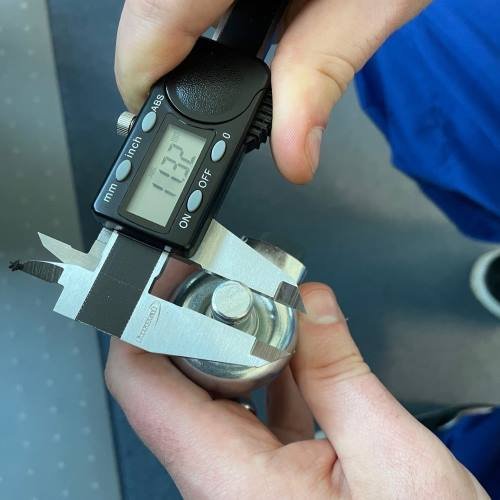
A customer reported that a retaining feature on some apparatus castors was below the agreed assembled condition and not seated in the groove. We checked the loose component with the manufacturer and confirmed its nominal dimension. Techin Castor then supplied an assembly tool and operating instructions. The lesson is simple: check the assembled castor, not only its parts.
Why can a correct castor component fail after assembly?
Assembly brings several parts and forces together. Their combined variation can create a defect that a loose-part check misses.
A finished castor has requirements loose parts do not: height, seating, axial play, swivel movement, and cleanliness.
A drawing controls one part. Assembly adds groove position, surfaces, force, tool alignment, and method. Each may meet its tolerance, but the result can still be out of limit. This is tolerance accumulation.
Final-inspection guidance for parts and assemblies notes that assemblies need final checks, not only process checks.[1]
Measure at least one finished characteristic; a component certificate cannot replace it.
| Inspection layer | Question | Example | Evidence |
|---|---|---|---|
| Component | Does each part meet its drawing? | Ring diameter or groove width | Inspection record |
| Assembly | Are parts seated after fitting? | Ring seating; assembled dimension | Finished measurement |
| Function | Does the castor work? | Retention, axial play, swivel | Functional check |
| Release | Does the lot meet the rule? | Sample result | Final report |
Which castor characteristics need a finished-state check?
Check the retaining feature, assembled dimension, axial play, swivel movement, and cleanliness.
For a ring or circlip retained in a groove, check these points:
- Confirm that the approved ring matches the groove design.
- Inspect seating around the full circumference, not just one angle.
- Measure the agreed feature from a stated datum with a named gauge.
- Look for deformation, damage, or incomplete engagement.
- Run the retention or axial-play check without damaging the sample. Turn the swivel head and wheel to check for binding.
- Check that grease and debris do not hide the seating area or affect the agreed external finish.
Rotor Clip’s installed-ring guidance links ring dimensions, permanent set, groove geometry, and installed function.[2] Use the approved design data; do not copy universal limits.
How should buyers define retaining-ring measurement?
Define the finished-state requirement with a characteristic, method, condition, limit, and decision rule.
For every critical retaining feature, record:
- Characteristic and datum: what is controlled and where it is measured.
- Method and condition: caliper, gauge, fixture, visual standard, or test; state whether the assembly is loaded and how it is positioned.
- Limit and decision rule: the numerical tolerance or attribute criteria, including how to treat borderline readings.
- Sampling stage: first piece, in-process, final, or incoming inspection.
- Record: result, instrument, inspector, and drawing revision.
How should buyers sample and release assembled castors?
Use four checkpoints: first piece, in-process, final lot, and receiving inspection.
| Checkpoint | Buyer purpose | Minimum evidence |
|---|---|---|
| First piece | Confirm the tool, method, datum, and finished characteristic | Signed result against the current drawing |
| In-process | Find drift while correction is practical | Time- or quantity-based records |
| Final lot | Approve the completed lot | Sample, defect class, acceptance number, and disposition |
| Receiving | Check shipment condition and supplier performance | Buyer result linked to the specification |
Define the lot, sample, defect class, acceptance number, and disposition for the castor and application.
If poor seating could let a component come loose, classify it separately from a minor appearance defect. The buyer may require tighter sampling or a complete check, based on application risk.
A useful supplier requirement is:
Measure the retaining feature after full assembly. Record the datum, instrument, result, and pass decision. Check seating and retention with the approved ring, groove, and test method. Submit first-piece and final-lot evidence.
Conclusion
Approve the assembled castor, not just loose-part certificates. Define seating, dimensions, function, measurement method, and sampling evidence before release.
Related Reading
References
- KEYENCE, Final inspection guidance. back
- Rotor Clip, Retaining-ring inspection guidance. back