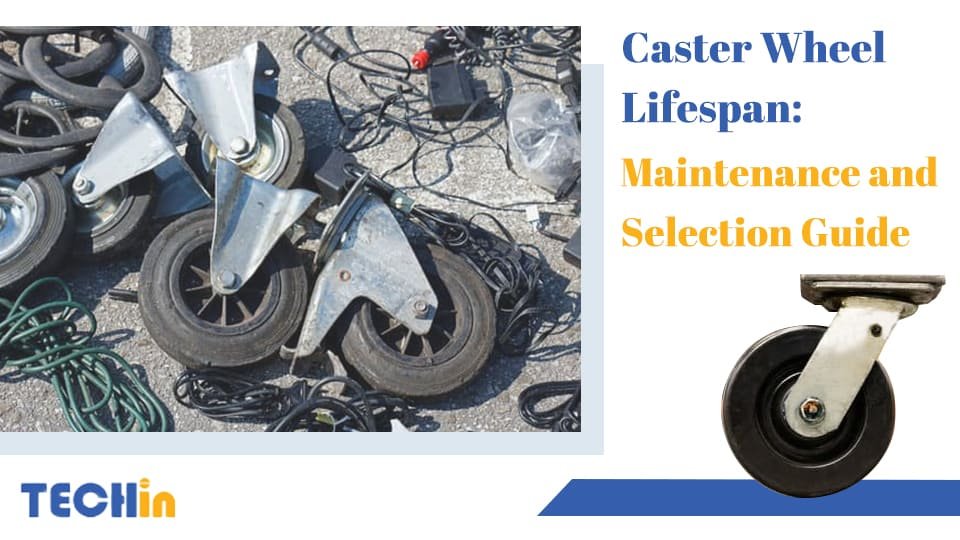
Worn-out casters cause delays and safety risks. Constantly replacing them eats into your budget. Understanding their real lifespan helps you choose and maintain them correctly, saving you money.
A caster wheel’s lifespan is not a fixed number. It can range from 1-2 years for a light-duty office caster to over 10 years for a well-maintained, heavy-duty industrial one. The final lifespan depends on material, load, usage, and maintenance.
Choosing the right caster can feel like a guessing game. You want something that lasts, but you also have a budget. I’ve spent 20 years in the caster business, and I’ve seen it all. The key isn’t just buying the most expensive caster; it’s about understanding how long a caster should last in your specific situation. This guide will walk you through everything I’ve learned, so you can make smarter purchasing decisions and get the most out of every wheel. Let’s dive in and demystify the lifespan of a caster wheel.
What is the Lifespan of a Caster Wheel?
Are you worried about your casters failing unexpectedly? This disrupts your work and throws your budget off. Knowing the real lifespan helps you plan better and avoid these costly surprises.
There is no single answer. A simple household caster might last 2-5 years. A robust industrial caster in a factory can last over 10 years. It all depends on the material, application, load, and your maintenance routine.
When we talk about lifespan, we are really talking about “service life.” This is the period a caster can perform its job safely and effectively. It is not just a date on a calendar. For example, a caster used 24/7 in a busy warehouse will reach the end of its service life much faster than the exact same caster used once a day. I remember a client who was upset his casters only lasted a year. When I visited his facility, I saw they were rolling through a chemical wash-down area daily, something the caster material wasn’t designed for. We switched him to a chemical-resistant nylon caster, and his problem was solved. The lifespan is determined by the work it does, not just the time that passes.
What Factors Influence Caster Wheel Lifespan?
Do your casters seem to wear out too fast? This costs you time and money in replacements. Understanding the key factors helps you extend their life and protect your investment.
The biggest factors are load capacity, floor conditions, the working environment, and how often you use them. Mismatching a caster to any of these conditions will drastically shorten its life. Proper, regular maintenance is also critical for longevity.
In my experience, overloading is the number one killer of casters. Many people look at the “static load” capacity, but the “dynamic load” capacity is what matters when the cart is moving. Always choose a caster with a capacity well above your heaviest expected load.
Here are the main things to consider:
- Load: Are you moving heavy or light items? Is the weight constant or does it change? Overloading causes the wheel material to deform and the bearings to fail.
- Floor Conditions: Smooth concrete is very different from a rough, cracked surface or a floor with debris. Rough floors act like sandpaper, wearing down the wheel tread much faster.
- Environment: Extreme heat can soften wheels, while extreme cold can make them brittle. Chemicals, oils, and even water can degrade certain materials over time.
- Usage: How fast and how far will the caster travel each day? Frequent starts, stops, and sharp turns put more stress on the swivel section and the wheel itself.
Does Caster Wheel Material Change Its Lifespan?
Choosing the wrong caster material means you will be replacing them frequently. This is a waste of your budget. Matching the right material to the job ensures durability and value.
Absolutely. A high-quality Polyurethane (PU) caster can last 3-5+ years in a busy warehouse. A basic Polypropylene (PP) caster might only last 1-3 years in the same role. Material choice is one of the most important decisions for caster longevity.
I’ve seen many customers, like Lenu in Italy, who are very budget-conscious but also need quality. The best way to meet both needs is to select the perfect material. It’s not about the cheapest option, but the one with the best value over time.
Polyurethane (PU)
PU is a fantastic all-around material. It’s extremely durable and wear-resistant, often lasting 3-5 times longer than rubber. It can carry heavy loads and resists many oils and chemicals. We often recommend this for demanding industrial applications.
Nylon (PA)
Nylon is very strong and has a low friction coefficient, so it rolls very easily on smooth floors. It’s tough and resistant to many chemicals. It’s a great choice for factories and warehouses where high load capacity and easy rolling are needed.
Rubber
Rubber provides a quiet, cushioned ride and is great for protecting floors. However, it wears faster than PU or Nylon and can be damaged by oils and some chemicals. It’s best for lighter loads or where noise is a concern.
Polypropylene (PP)
PP is a lightweight and low-cost option. It is resistant to water and many chemicals. However, it’s not as durable or impact-resistant as Nylon or PU, making it suitable for light-duty applications where cost is the main driver.
| Material | Typical Lifespan (Industrial Use, 8hr/day) | Key Strengths |
|---|---|---|
| Polyurethane (PU) | 3 – 5+ years | Excellent wear resistance, high load capacity |
| Nylon (PA) | 3 – 8 years | High strength, low rolling resistance, chemical resistant |
| Rubber | 2 – 5 years | Quiet operation, shock absorption |
| Polypropylene (PP) | 1 – 3 years | Low cost, good chemical resistance |
| TPE | 2 – 4 years | Quiet, non-marking, good elasticity |
How Does Caster Wheel Usage Affect Its Lifespan?
Using an office chair caster on a heavy factory cart is a recipe for disaster. This causes downtime and safety hazards. Understanding application-specific lifespans prevents these costly mistakes.
Usage is critical. A light-duty caster on a home project cart might last 2-5 years with infrequent use. But a heavy-duty industrial caster in a 24/7 factory might need replacing in 3-5 years, even if it’s very high quality.
The expected lifespan changes dramatically based on the caster’s job. You cannot expect a caster designed for a hospital bed to survive on a 500kg manufacturing cart. That’s why we, as a manufacturer, offer such a wide range of products. We need to provide the right tool for the right job.
Household or Light-Duty Use
These casters are for things like office chairs, small furniture, or DIY projects. They see infrequent use and light loads. Lifespan is typically long, but the components are not built for industrial stress.
Industrial or Heavy-Duty Use
This is our specialty. These casters are for warehouse carts, platform trucks, and manufacturing equipment. They are built with stronger forks, more durable wheels like PU or Nylon, and robust bearings to handle heavy loads and constant motion. Even so, in a harsh, 24/7 environment, their life will be shorter than in a light-duty setting.
Medical or Precision Use
These casters have special requirements. They must be quiet, non-marking, and often resistant to cleaning chemicals and frequent disinfection. They have a good lifespan but may need replacement based on hygiene protocols, not just wear and tear.
| Use Case | Typical Lifespan | Common Materials | Key Demands |
|---|---|---|---|
| Household/Light-Duty | 2 – 5 years | PP, Rubber, TPE | Low cost, floor protection |
| Industrial/Heavy-Duty | 3 – 10+ years | PU, Nylon, Cast Iron | High load capacity, durability |
| Medical/Precision | 3 – 8 years | TPE, special Nylon | Quiet, clean, chemical resistant |
What are the Telltale Signs of a Bad Caster?
A failing caster can seize up without warning. This can damage your floors, your products, or even cause accidents. Knowing the warning signs lets you perform proactive replacement.
Look for difficulty in rolling or swiveling, and listen for unusual noises like squeaking or grinding. Also, check for visible damage like cracks or flat spots on the wheel, and any wobbling. These are clear signs your caster is failing.
You need to know what to look for before a complete failure happens. I once visited a customer in Germany, Hans, who managed a large manufacturing plant. He complained his carts were becoming very hard to push. We inspected them and found the swivel bearings were completely clogged with metal shavings from his production floor. This grinding was a clear warning sign. We showed his team how to spot this early.
Here are the main symptoms of a failing caster:
- Difficult Movement: If you have to push much harder to get the cart rolling, the bearings may be failing or clogged.
- Swivel Problems: The caster refuses to turn smoothly or gets stuck in one direction. This is often a problem in the swivel raceway.
- Unusual Noise: Squeaking can mean it needs lubrication. A grinding or crunching sound often points to a failed bearing that needs immediate attention.
- Visible Wheel Damage: Look for deep cracks, chunks missing from the tread, or a “flat spot” from being dragged while seized.
- Wobbling: If the wheel wobbles on its axle or the entire caster wobbles, it means parts are loose or worn out.
When To Replace Caster Wheels?
Waiting too long to replace casters puts safety at risk. But replacing them too soon wastes money. Knowing the right time to act is the key to efficient operations.
Replace casters immediately if you see significant cracks, flat spots, or a bent frame. You should also replace them if they no longer roll smoothly or swivel freely, even after cleaning and lubrication. Do not wait for a complete failure.
The decision to replace a caster should be based on performance and safety, not just age. A caster’s failure can cause much more damage than the cost of a new caster itself. Think about the value of the products on your cart or the cost of an employee injury. It is always cheaper to replace a caster proactively. I advise my clients to have a simple rule: if it looks broken or doesn’t work smoothly after maintenance, replace it. Don’t take the risk.
Here’s a simple checklist:
- Immediate Replacement:
- The wheel is cracked or has pieces missing.
- The metal fork or top plate is bent or cracked.
- The wheel is seized and will not turn at all.
- Plan for Replacement:
- The wheel tread is significantly worn down.
- The caster wobbles excessively.
- It makes a constant grinding noise.
- It requires much more force to move than a new caster.
How Can You Properly Maintain Caster Wheels to Extend Their Life?
Are you throwing money away on new casters? Neglecting basic maintenance is often the cause. A simple, regular routine can easily double a caster’s lifespan and save your budget.
Regularly clean the wheel and housing to remove any tangled debris like string or hair. Check and tighten all fasteners, including the axle nut and mounting bolts. Most importantly, lubricate the swivel raceway and wheel bearings as needed.
Maintenance is the single most effective way to get more life from your casters. It’s simple and doesn’t take much time. I always tell my customers that five minutes of maintenance per month can save them from a huge headache and expense later on. It’s a small investment with a big return.
Here is a basic maintenance schedule you can follow:
- Inspect Regularly: Once a month, take a quick look at your casters. Check for the warning signs we discussed earlier.
- Clean Thoroughly: Remove any hair, string, plastic wrap, or other debris wrapped around the axle. This is a very common cause of failure. A brush or compressed air works well.
- Tighten Hardware: Check that the mounting bolts holding the caster to the cart are tight. Also, check the nut on the wheel axle. A loose caster can cause a lot of problems.
- Lubricate Moving Parts: The most important step. Apply grease to the swivel raceway (the ring of ball bearings in the top of the fork) and to the wheel bearing if it’s designed to be lubricated. This keeps everything moving smoothly.
How Do You Choose Caster Wheels That are Built to Last?
Buying the cheapest casters seems like a smart way to save money. But they often fail quickly, costing you more in downtime and replacements in the long run.
To choose a lasting caster, first match the wheel material to your floor and environment. Second, ensure the load capacity is at least 25% higher than your heaviest load. Finally, work with an experienced supplier who can guide you.
Choosing the right caster from the start is the best way to ensure a long service life. After 20 years of manufacturing and supplying casters to Europe, I’ve learned that our job is not just to sell a product. It’s to help our clients make the right choice. We ask about their load, their floors, and their work environment. We help them think about things they might have missed. For a detail-oriented buyer like Hans in Germany, we make sure the caster meets all EN standards and provide full technical specifications. For a budget-focused buyer like Lenu in Italy, we find the most durable material for their specific application that fits within their budget. A good supplier is a partner who helps you invest wisely.
Conclusion
Choosing the right caster and maintaining it properly are the keys to a long service life. This saves money, increases safety, and makes your entire operation run more smoothly.